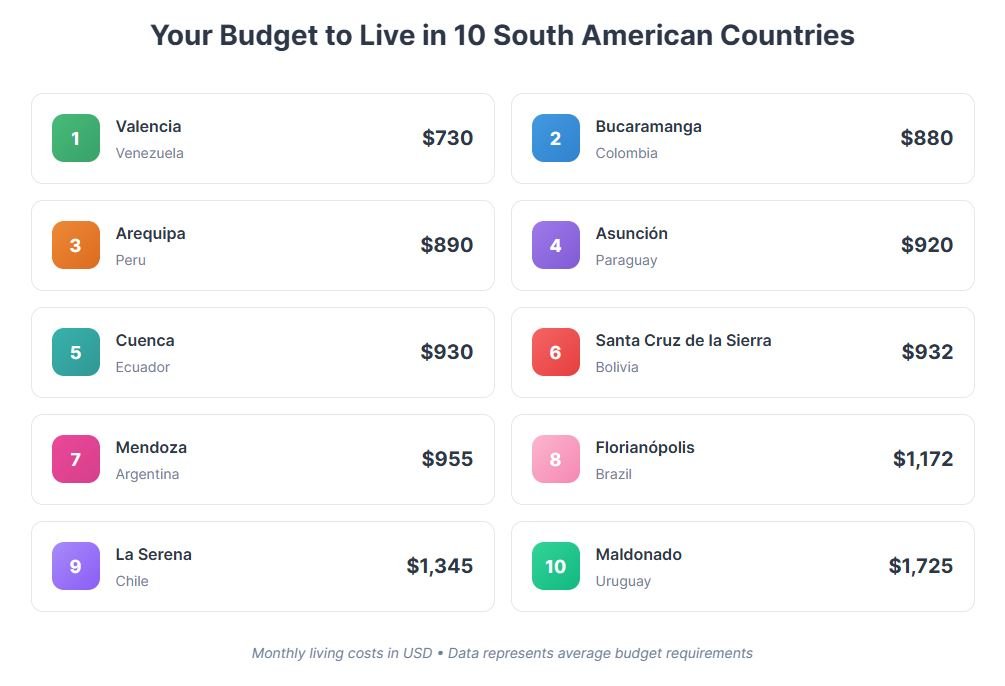
The cost of living in the cheapest South American country is just $730 per month.
The most expensive?
$1,725. – That’s almost two and a half times the cost for what appears to be the same lifestyle.
But after 26 years living in South America, I can tell you this price gap is the direct cost of three things every retiree needs: quality of life, safety, and stability.
The most expensive has first-world infrastructure and healthcare.
The cheapest? Enormous risks.
And it might sound odd but… The cheaper options cost you more. The expensive one saves you money.
So today, you’ll see the numbers side by side, and you’ll know exactly what you gain—and what you avoid—when you spend that extra money.
The Criteria
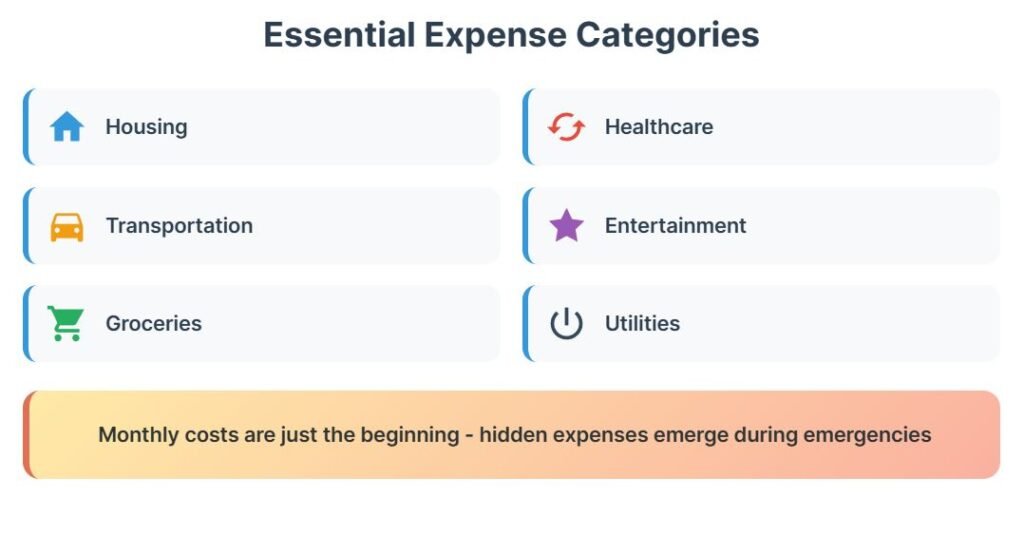
Every expat faces the same six expense categories: housing, healthcare, transportation, entertainment, groceries, and utilities.
But here’s what some people miss: the real cost isn’t what you pay monthly.
It’s what you pay when things go wrong.
The cheapest countries save you money upfront, but cost you when the power goes out for days, or when you need emergency medical care.
The expensive countries charge you a premium for one thing: predictability.
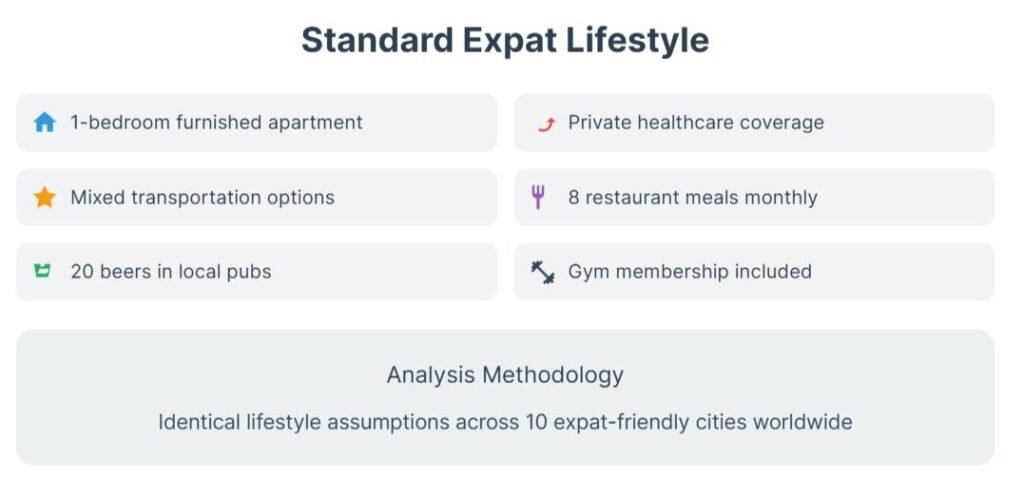
We analyzed ten countries using identical lifestyle assumptions.
- One-bedroom furnished apartment in a safe area.
- Private healthcare.
- Mix of public transport and ride-hailing.
- Eight restaurant meals per month, twenty beers in a local pub, gym membership.
A $700 monthly budget sounds attractive until you spend $2,000 flying to another country for dental work because local clinics ran out of anesthetics.
A $1,700 monthly budget looks expensive until you realize most services work as advertised and life is just… easier.
To calculate costs like rent, for each country, I chose a city that, compared to others in the same country, is attractive to expats and often mentioned among our viewers.
The only expense I left out is taxes, because they depend on how your income is obtained, so the article would be too long.
But if you would like a article where I also cover taxes, tell me in the comment section.
In my other rankings, I usually start with the worst and most expensive, but here, I will do the opposite, and start with the cheapest one, because in South America, the cheapest is also the worst.
10th Place – Venezuela
For Venezuela, we analyzed Valencia, a major urban center located about two hours west of Caracas. On paper, Venezuela is the cheapest country in South America, with a total monthly cost of just $730. That’s less than what many people in the United States spend on their car loan alone.
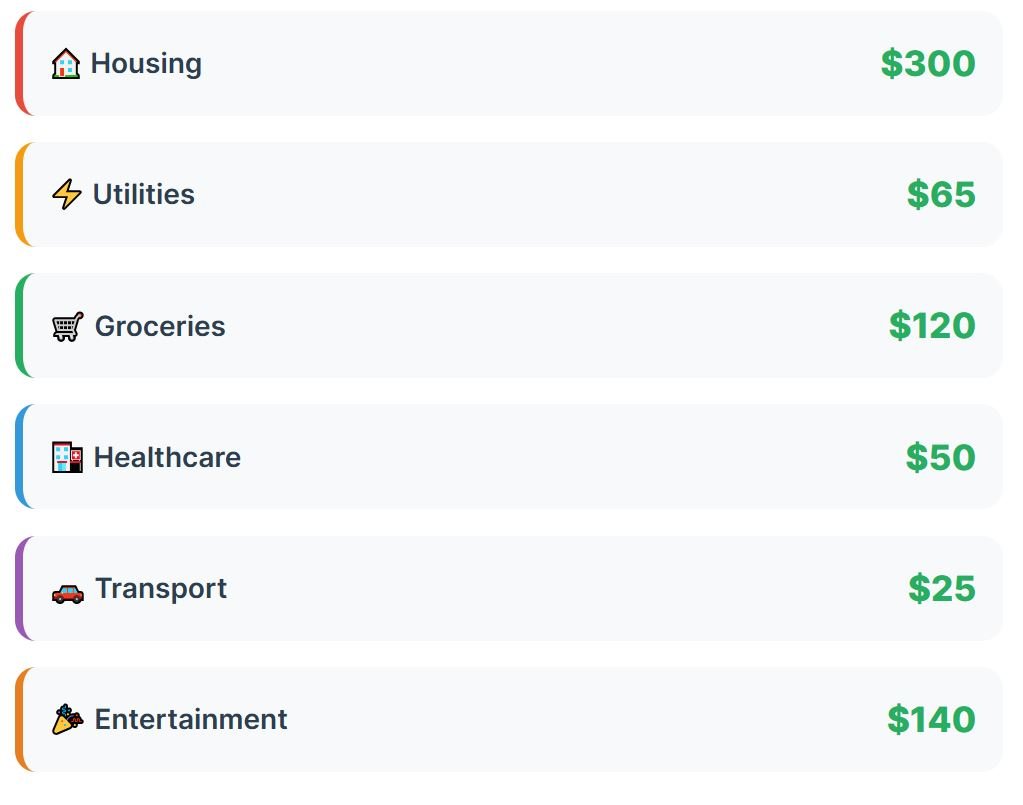
The numbers look almost impossible to believe. Housing in a modern building in a walkable neighborhood goes for just $300 per month. Utilities come to $65.
A grocery budget of $120 gives you access to a mix of supermarkets and fresh local markets. Healthcare coverage through a private plan costs only $50 per month. Transportation costs just $25.
And a generous entertainment budget of $140 covers eight restaurant meals, twenty beers at a pub, and a gym membership. But these numbers exist in a vacuum. They represent a best-case scenario that ignores the country’s profound instability.

Venezuela’s infrastructure fails without warning, and its public services disappear overnight. The currency can lose half its value in a matter of months, as hyperinflation has been a normal occurrence for many years already. And it is a very, very violent country.
I came from a violent country in South America, but compared to Venezuela, my country is a walk in the park. And such violence changes everything. When you look for a place to rent, it is not enough to check the building itself; you must also pay attention if the location is not too dangerous.
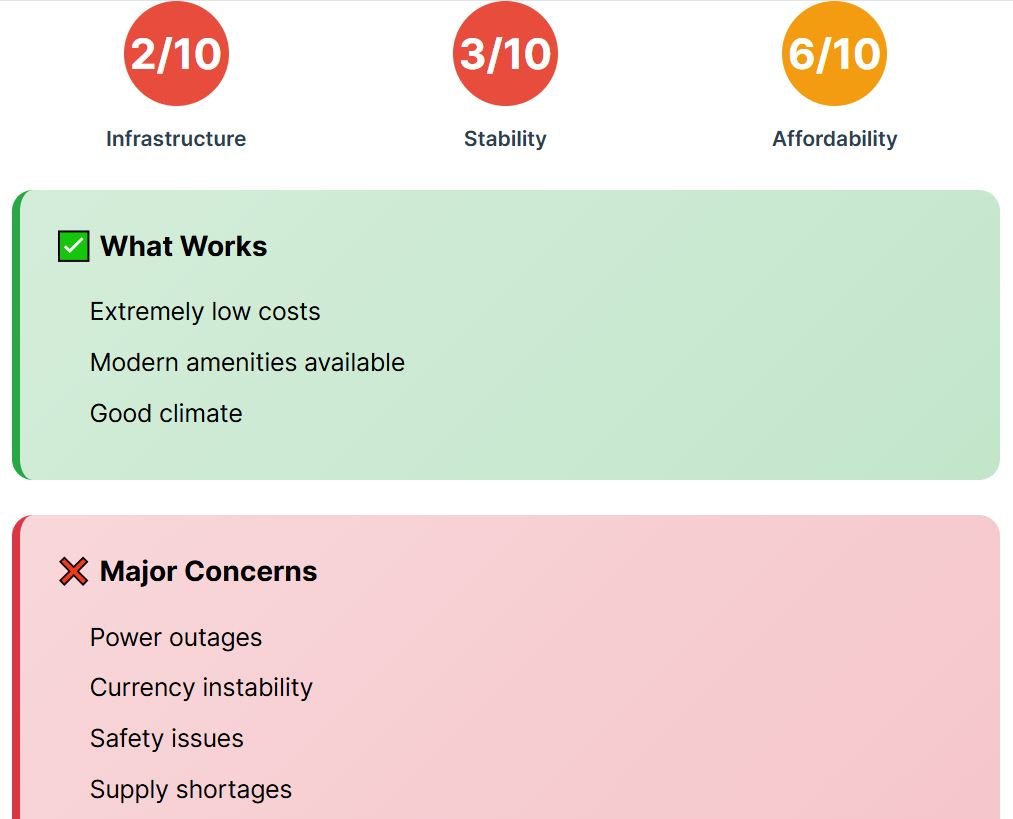
Your $65 utility budget assumes the power stays on and the internet connection is stable. Your $120 grocery budget assumes the shelves at the supermarket are actually stocked with food. Your $50 healthcare plan assumes the private clinic has medicine and its doctors haven’t left the country.
The low costs are real, but the risks are just as real. You are betting that absolutely nothing goes wrong in a country where things go wrong all the time.
9th Place – Colombia
For our ninth-place country, Colombia, we look at Bucaramanga, located in the country’s green northern mountains. The cost there is $880 per month. That’s just $150 more than Venezuela, but this small price jump buys you entry into a different world.

The primary difference is reliability. Housing in Bucaramanga climbs to $350, and private healthcare doubles to $100 compared to Venezuela. That extra money directly translates into stability.
The power grid is dependable, and the water runs consistently. The hospitals are functional and supplied. Your bank accounts remain accessible and are not subject to sudden government freezes like in Venezuela.

Bucaramanga, with its year-round spring weather, has a growing expat community. This is because you can build a life on low budget numbers. A transportation budget of $50 covers a mix of public transit and ride-hailing services like Uber that are reliable and show up when you book them.
Your $130 entertainment budget is spent at restaurants that are open for business day after day, not closing without notice due to supply chain issues. The city provides a stable foundation for a long-term plan. The healthcare system widely accepts international insurance plans, removing a huge layer of financial friction for expats.

For a cost that is only about 20% higher than in Venezuela, you acquire a level of stability that is orders of magnitude greater. This is the point in our ranking where you begin to see a crucial calculation that smart expats make. A slight increase in your fixed monthly costs can lead to a dramatic reduction in your overall risk.
The total for one person comes to $880 a month, a price that buys you functional infrastructure and the ability to plan for the future.
It will be such a great help for us.
8th Place – Peru
In eighth place, we have Peru, with a monthly cost of $890 in the city of Arequipa. This budget is nearly identical to what you’d spend in Colombia, but the value proposition is quite different. Arequipa delivers good infrastructure without the inflated prices you find in major tourist hubs like Cusco.
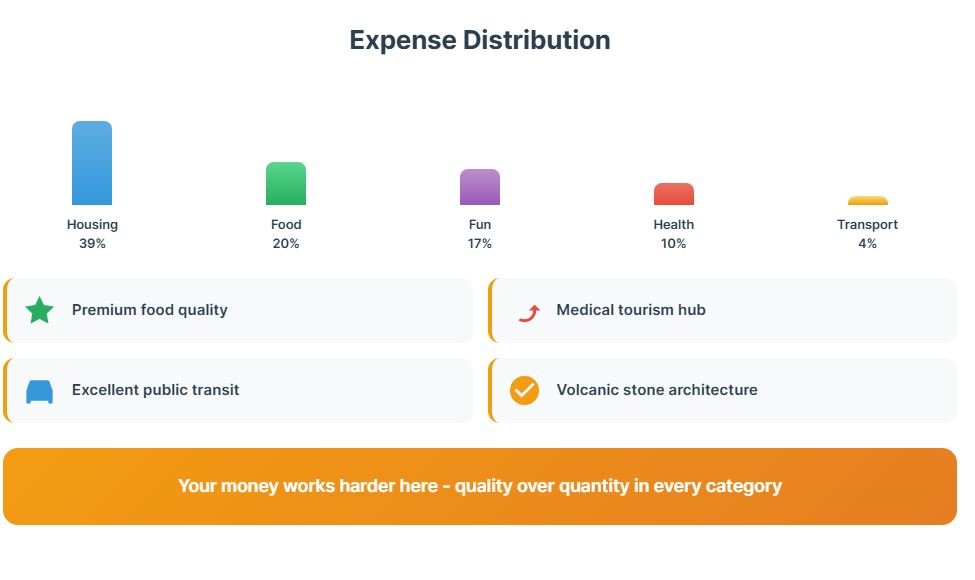
Your housing cost remains stable at $350, matching the price in Bucaramanga for a similar apartment. The country’s competitive medical tourism industry is reflected in its healthcare costs, which drop to just $90 for a private plan. This provides access to quality medical care for less than in neighboring Colombia.
Transportation is also more affordable, costing only $35 a month. Your entertainment budget of $150 also carries more value for money in Arequipa than almost anywhere else on our list. It stretches to cover meals at traditional picanterías where locals eat, entry to vibrant neighborhood festivals that happen year-round, and participation in cultural events that often cost very little.
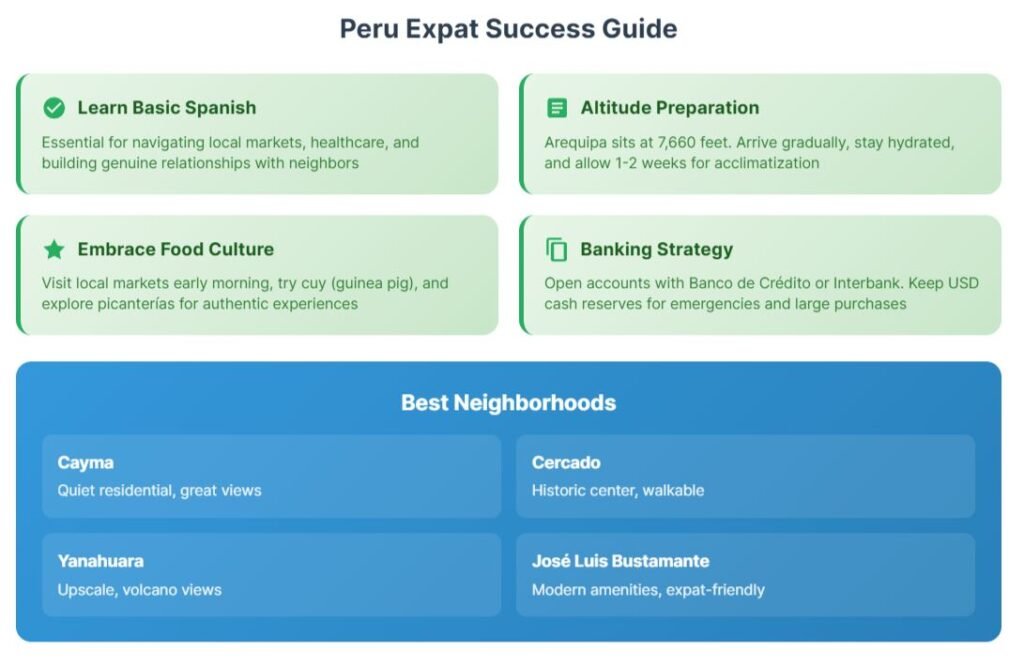
This is where your money shifts from simply covering needs to actively funding a rich, culturally engaged lifestyle. And what you get in return is an authentic lifestyle, not a curated one. For one person, the total monthly cost to live this life in Peru is $890.
7th Place – Paraguay
Coming in at number seven is Paraguay, with a monthly budget of $920 to live in its capital, Asunción. The country’s relative obscurity is its main appeal for expats who are looking for a low-profile destination. Compared to the previous names, your budget allocation changes considerably in Paraguay.
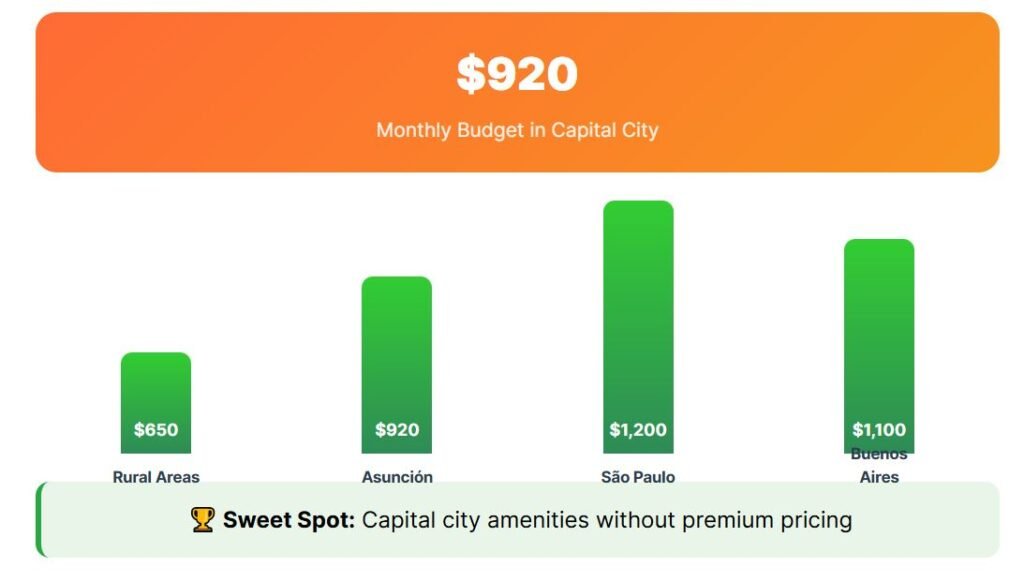
Housing costs jump to $400, the highest we have seen so far in our ranking. This price gives you access to the amenities and infrastructure of a capital city but spares you the congestion and inflated prices of more popular destinations. You get the benefits of a national hub without the typical drawbacks.
This higher housing expense is offset by a sharp drop in healthcare costs. A private plan with access to modern medical facilities costs just $75 per month, which is one of the lowest prices for this level of care you will find anywhere in South America. Paraguay offers a unique proposition: it is undergoing rapid development without the usual growing pains.
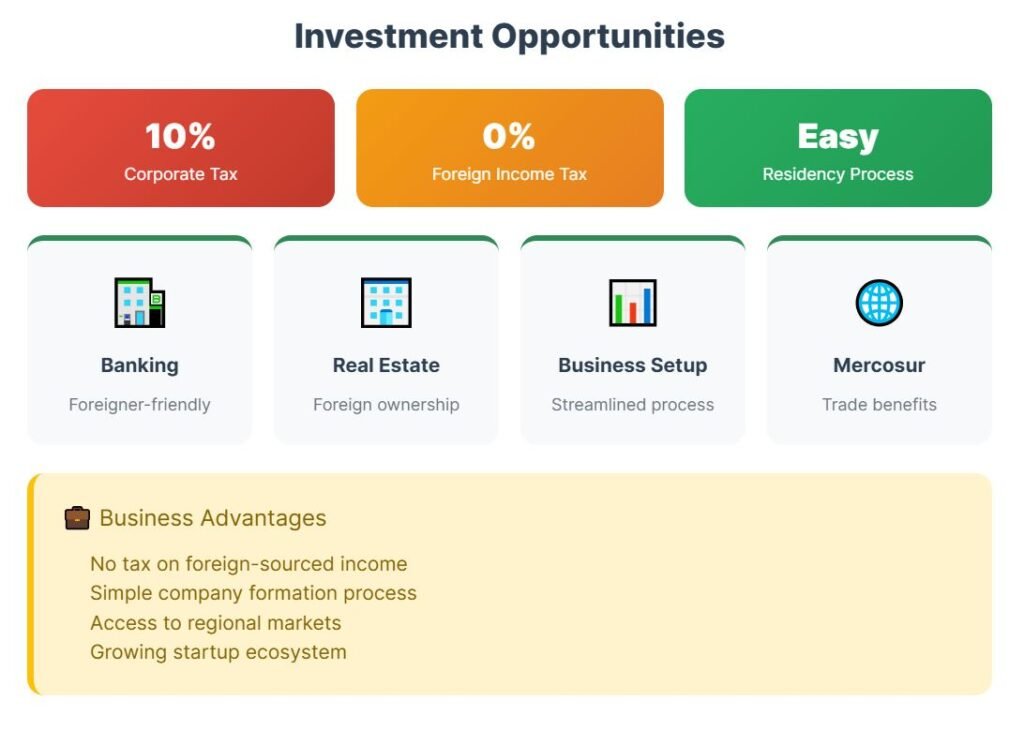
The government is actively modernizing the country’s infrastructure, expanding its international connections, and successfully attracting foreign investment. At the same time, it has not yet become a major destination for expats or tourism. This creates a window where you can experience the benefits of growth without paying a premium for them.
Your grocery budget of $170 directly reflects this. You benefit from Paraguay’s agricultural abundance, with fresh meat, high-quality produce, and dairy products available at prices that make neighboring countries seem expensive. Other expenses remain moderate, reflecting a country that is developing but still affordable.

Transportation costs are $40 a month, utilities $95, and our entertainment budget is $140. For a total of $920 a month, you are buying into a country’s growth story before the rest of the world catches on and prices rise. One expat described Asunción as “the South American capital nobody talks about, which is exactly why it works.”
It represents a ground-floor opportunity.
6th Place – Ecuador
Ecuador comes in at number six, with a monthly cost of $930 per month, using the city of Cuenca as our model. This city is a UNESCO World Heritage colonial site that has been a primary destination for American retirees for more than two decades. This long-standing relationship has cultivated one of the most established and comprehensive infrastructures for expats found anywhere on the continent.
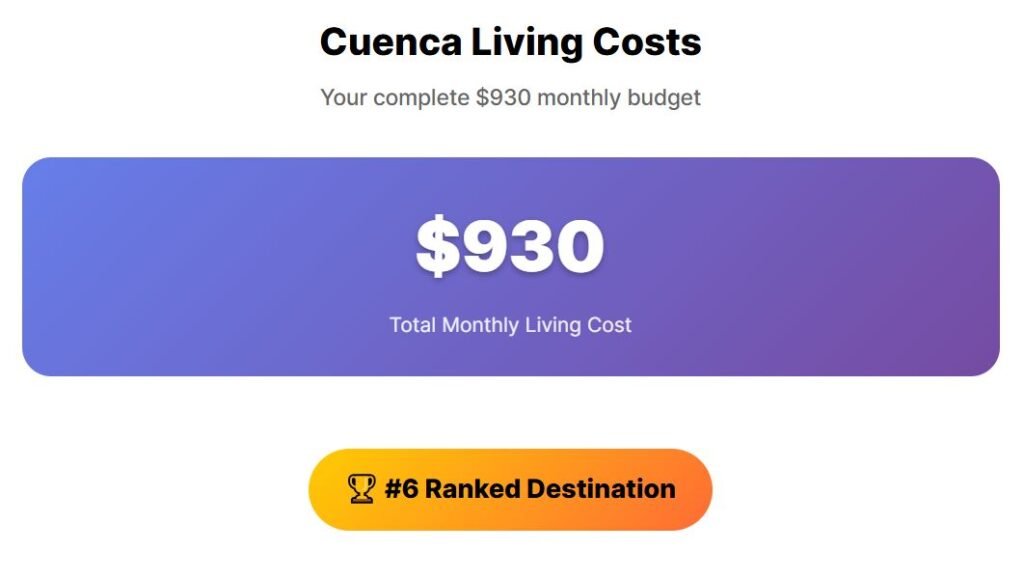
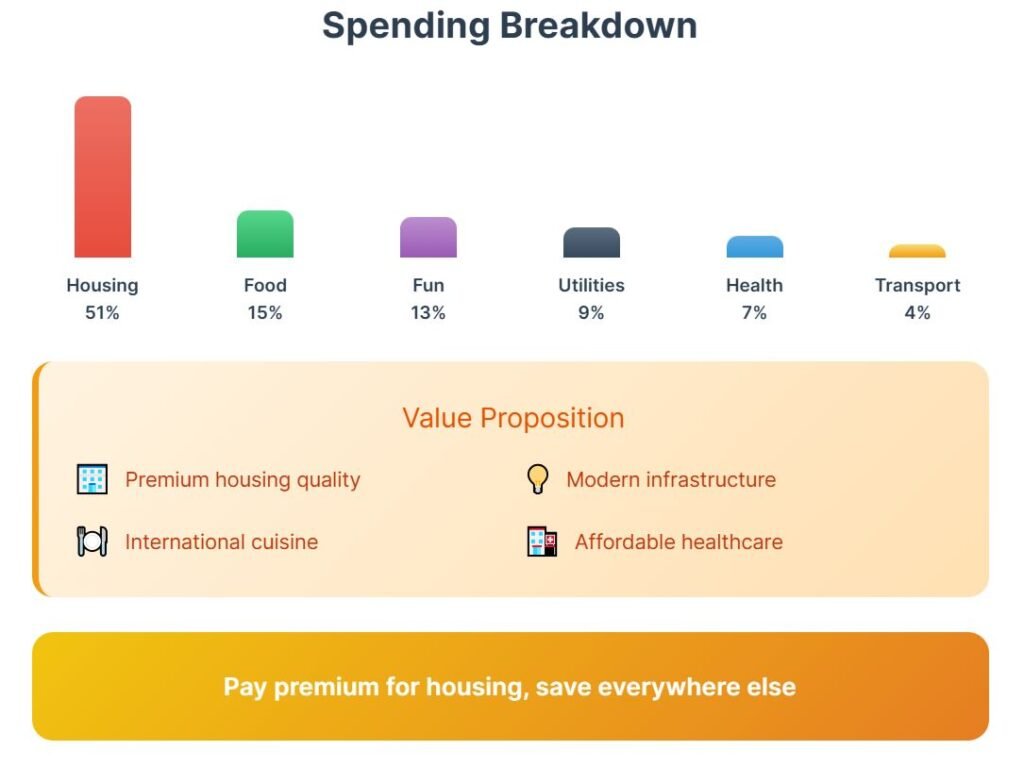
Let’s look at the budget breakdown. Housing costs are on average $380 per month for a comfortable apartment, and private healthcare is an affordable $90. But the numbers themselves don’t capture the full value.
The city’s compact and walkable layout keeps transportation costs down to just $40 per month for a mix of public transit and occasional taxis. What makes Ecuador, especially in a city like Cuenca, so distinct is that many services are specifically oriented toward the needs of the foreign community. You will find a high concentration of English-speaking doctors, dentists, and specialists.
The banking sector is accustomed to foreign clients and offers international services that simplify managing finances from abroad. There are also numerous dedicated expat events and social clubs. The natural environment itself also directly contributes to the low cost of living.

Cuenca’s location high in the Andes provides a year-round spring-like climate. Your entertainment budget of $160 also goes further here than in many other places. For one person, the total monthly cost to live this well-supported lifestyle in Ecuador stands at $930.
Now we go to the top half of our ranking, but before, I have some really good news:
My Expat Wealth & Lifestyle Compass (valued at $108) is yours FREE for a limited time! Receive our 74-page analysis of affordable cities in Spain, Italy, and France; our guide for Zero-Income Tax countries that can save you up to $15,600; and the checklist that prevents costly mistakes. Don’t let your chances go away-join us for free!
5th Place – Bolivia
In fifth place, Bolivia comes in with a monthly cost of $932. Some people would expect it to be much cheaper than countries like Peru or Colombia, but there are some surprises about this landlocked country. Santa Cruz de la Sierra is our proxy city, a tropical metropolis in the lowlands that is like the Bolivian Miami.
This city is defined by its modern shopping centers, a diverse and growing scene of international restaurants, and a dynamic economy that sets it apart from the rest of the country. It is an entirely different Bolivia than the one most people picture. This modern environment directly shapes your budget.
Housing costs take a significant jump to $479, but that also means better quality of life. What you get for that money is a modern apartment with contemporary amenities, located in what is currently South America’s fastest-growing major city. This premium for living space is then offset by the remarkable efficiency in other parts of the economy, which keeps most of your other daily costs low.

For instance, private healthcare coverage drops to a very manageable $65 per month. Your groceries will cost about $140, and transportation, using a mix of public and private options, is only $40. This unique cost structure allows you to access good infrastructure while keeping your total budget just over the $900 mark.
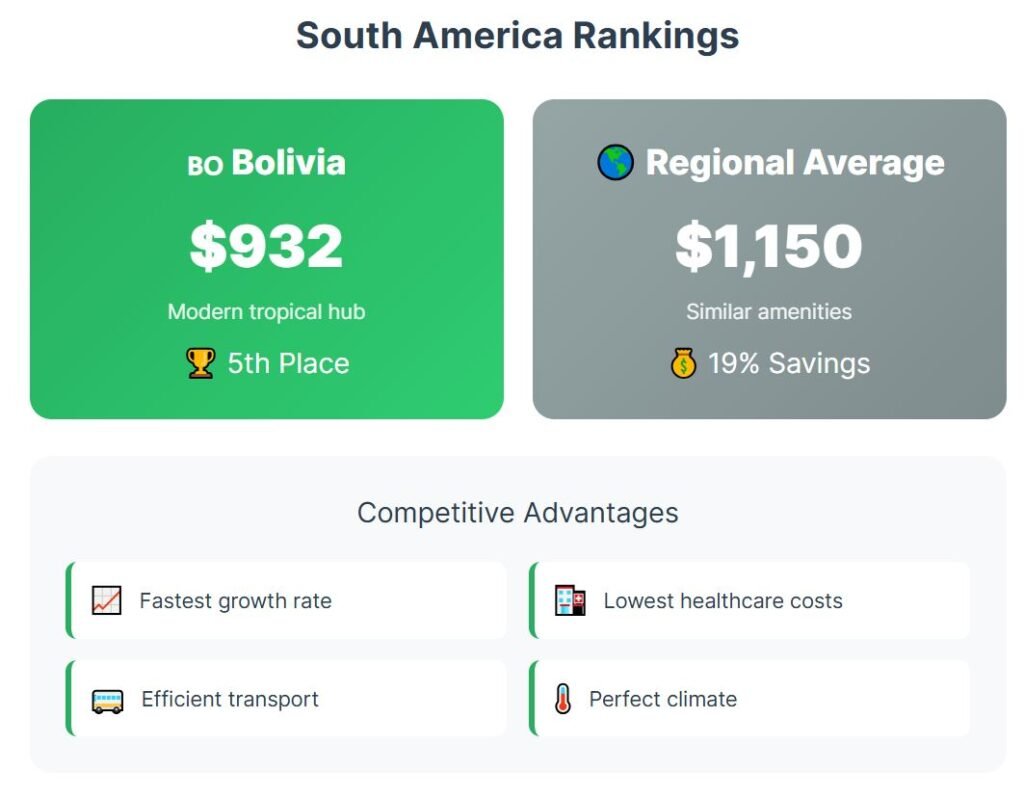
The key to understanding this dynamic is recognizing Santa Cruz’s role as the engine of Bolivia’s economy. This single city generates over 30% of the entire country’s GDP while being home to only 15% of its population. This powerful economic activity is a magnet for international businesses.
Your $120 entertainment budget also benefits from this commercial vibrancy, as dozens of restaurants, bars, and theaters compete for a sophisticated local market, which keeps prices competitive and quality high. The total monthly cost for one person is $932. This price point gets you a modern, functional, and surprisingly cosmopolitan lifestyle in a tropical setting.
4th Place – Argentina
In fourth place, we land in Argentina, with a monthly cost of $955 using the city of Mendoza as our benchmark. This budget, however, comes with a significant warning label: the country’s economic situation changes faster than the local wine vintages. Argentina offers a sophisticated, urban lifestyle, surrounded by the stunning Andes mountains and some of the world’s most acclaimed vineyards.
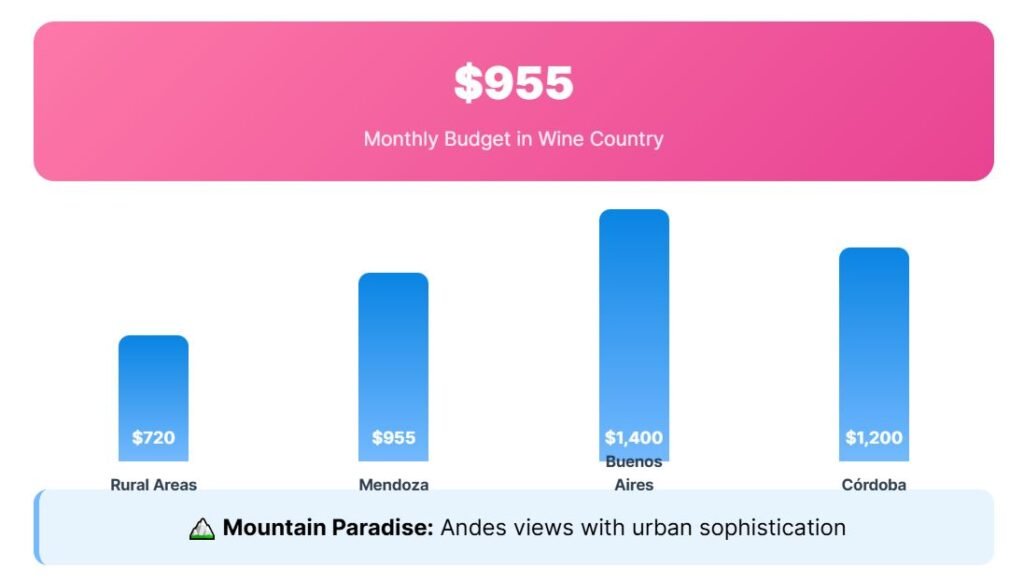
When we break down the budget, we see a peculiar allocation of funds. Housing costs actually drop to $360 per month, and private healthcare is a very low $60. These figures are much lower than in some cheaper countries on our list.
But the savings are immediately redirected, and even surpassed, by a massive jump in the entertainment budget, which skyrockets to $225 per month. This is for a good reason, since Mendoza has a refined scene. The city’s DNA is composed of wide, tree-lined avenues, bustling public plazas filled with people late into the evening, and a sidewalk café society that forms the backbone of its social life.

Your daily routine can feel a world away from the rest of South America. But here is the unavoidable catch that every expat in Argentina faces: severe currency volatility means your monthly costs can shift dramatically with no warning at all. On one hand, this makes your dollar-based savings go much further, and you can suddenly afford luxuries that were out of reach the month before.
On the other hand, this deep instability makes any long-term financial planning more difficult. You can’t reliably budget for the next year when the real dollar cost of your rent or groceries is a moving target. You trade long-term certainty for short-term affordability.
Still, Argentina offers good infrastructure for a price under US$1000. For one person, the total cost is $955 a month.
3rd Place – Brazil
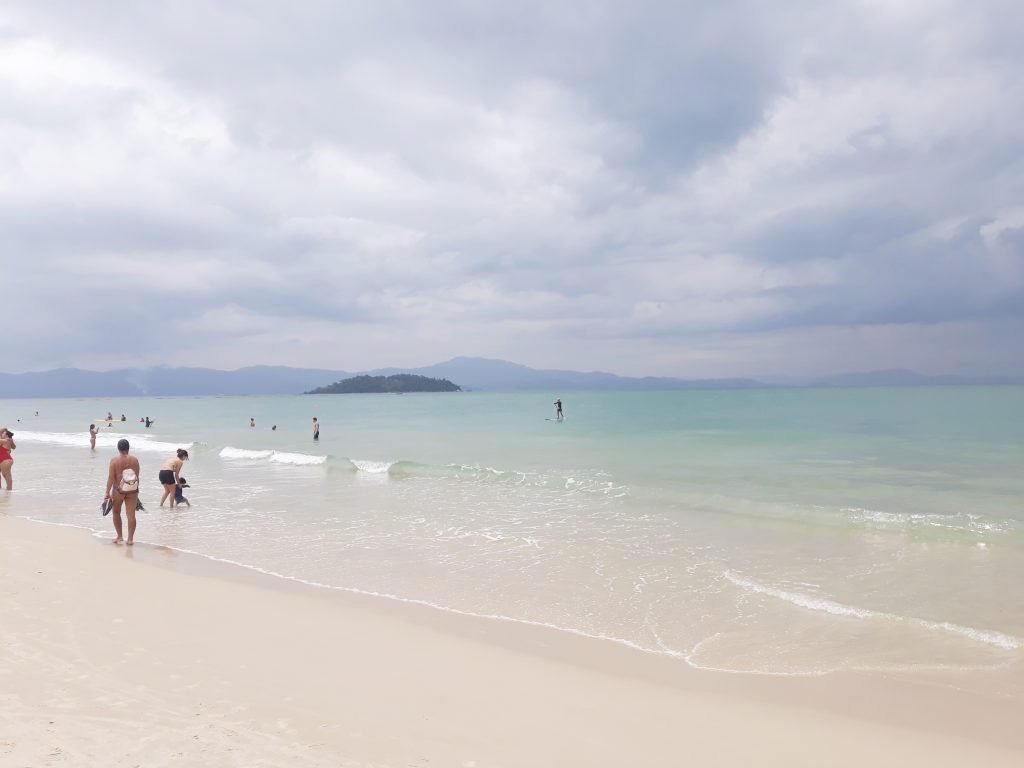
In the top 3 most expensive, we arrive in Brazil, where the monthly cost breaks into four-digit territory for the first time on our list, totaling $1,172. For this analysis, we use Florianópolis, an island city that merges a relaxed beach culture with the dynamism of Brazil’s second-largest technology sector. It’s a place for people who want both the sand and the silicon.
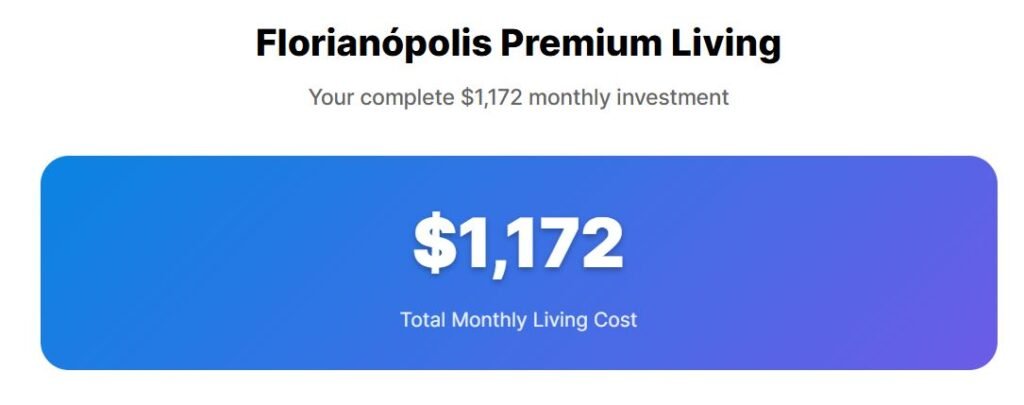
The higher cost of living is visible in your primary expenses. Housing jumps significantly to $495 per month for a desirable one-bedroom apartment, and private healthcare coverage increases to $150. You are clearly paying a premium here, but that money is an investment in what is considered one of Brazil’s 4 best state capitals in quality of life.
What you get for this price is something rare: good and reliable infrastructure, set against a backdrop of dozens of tropical beaches, all within a vibrant and growing international community. The city actively attracts skilled tech workers from all over Latin America and beyond, which in turn cultivates a sophisticated, English-speaking professional network that most coastal retirement spots simply cannot offer. This figure mirrors not just Brazil’s generally higher cost of living but also represents a substantial step up in both quality and variety.
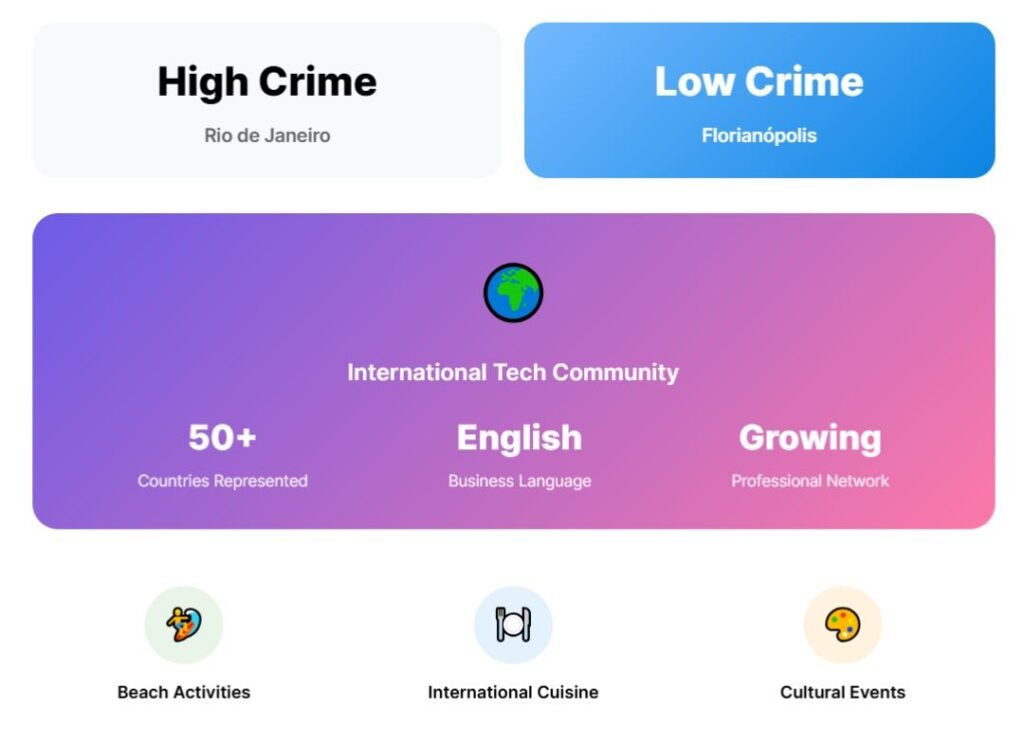
Other costs continue to align with this principle of paying for quality. The beaches there are on par with those in more famous Brazilian destinations like Rio de Janeiro or Salvador, but the crucial difference lies in what surrounds them: superior infrastructure, and much, much lower crime rates. For one person, the total monthly cost to live in such a developed part of Brazil is $1,172.
2nd Place – Chile
Our second most expensive country is Chile, which represents another major jump in expenses. The total monthly cost, using the coastal city of La Serena as our model, comes to $1,345. It is because in Chile you are paying for a guaranteed level of quality and consistency that removes the daily friction common in other parts of the continent.
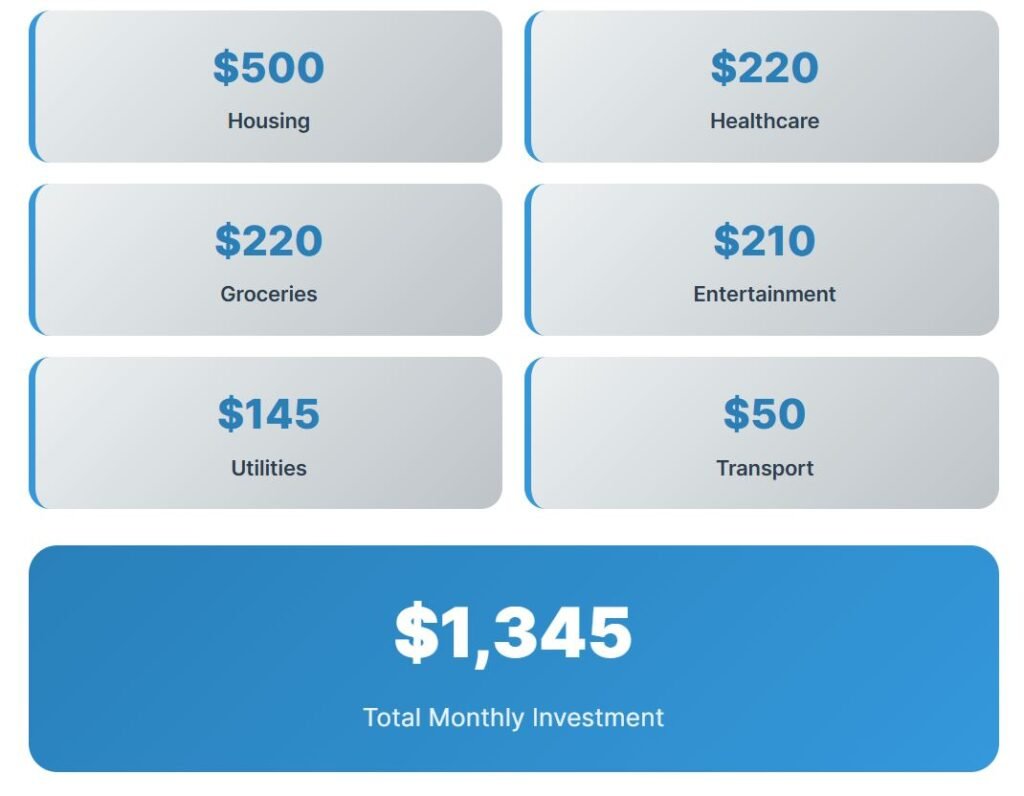
The budget numbers reflect this reality. Healthcare costs climb to $220 per month for a private plan. Your grocery bill averages $220, and the cost for utilities, including power and internet, reaches $145.
These are figures you might expect to see in parts of Europe, and that is precisely the point. You are paying European-level prices because you are receiving European-quality services in return. This premium buys functional infrastructure, stable institutions, and service providers that deliver exactly what they promise.

The electricity grid is stable, tap water is potable, and high-speed internet is reliable, all of which are critical for anyone working remotely or simply wanting a stress-free retirement. This reliability extends to every aspect of daily life. Your housing budget of $500 secures a modern apartment with consistent utilities.
On a national level, Chile’s institutions are built for a level of performance way above what one could expect in South America. The healthcare system meets international standards of care, and many government services are digitized, allowing you to handle official business online without navigating a frustrating bureaucracy. Even areas with lower costs are a byproduct of this efficiency.

Transportation costs are lower not because service is basic, but because lower taxes and competition between providers push prices down. I lived in Chile, in Las Condes, for a time—and the impression I had is that it does not even look like South America. Almost everything functions like you expect it to in a developed country.
For a total of $1,345 a month, your money is paying for the profound peace of mind that comes with living in a place where most things work as they should.
01st Place – Uruguay
At the top of our list, the most expensive country in South America for retirees is Uruguay. The monthly cost there, using Maldonado as our price proxy, is $1,725. This figure is nearly triple our starting point in Venezuela, but it represents the ultimate investment in personal safety and long-term stability on the continent.
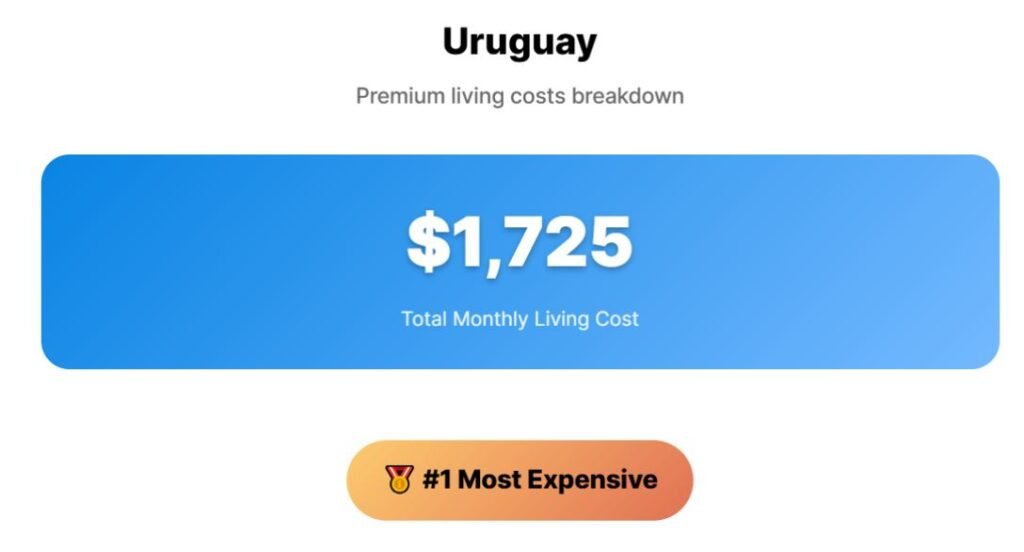
The price reflects a country that has deliberately chosen to prioritize quality over bargains in every sector. This philosophy is clear in the budget breakdown. Housing costs rise to $800, your grocery bill will be about $300, and utilities come in at $155.
These are not numbers for a budget destination; they are the price for a first-world standard of living. So, what exactly justifies this premium? The answer is simple: Uruguay consistently ranks as South America’s safest, most stable, and most democratic country.
This is not a subjective opinion; it is a measurable reality that translates directly into your quality of life. The country offers something no other nation in South America offers: nice beaches, unwavering political and economic stability, and tax incentives for expats. Uruguay has not experienced a military coup, a major currency crisis, or significant political upheaval in decades.
No big protests, no riots, no major disruptions to life. Only the sound of sheep (many, many sheep). Using Maldonado as a base gives you pleasant beach access, good infrastructure, and convenient proximity to Montevideo, and even Buenos Aires, but without the complications inherent in those large urban centers.
For one person, the total monthly cost is $1,725. For that price, you are not just buying a comfortable lifestyle. You are buying stability (and, of course, some nice tax incentives).
Now you know the costs in every South American country – but what are the best cities to live in places like Chile, Argentina, Uruguay or Colombia? When considering life in south america, cities like Santiago, Buenos Aires, and Montevideo stand out.
In one of my most important articles EVER, I ranked the BEST cities in South America to move to.
And join my Patreon for all the sources and charts from our articles, plus a chat, so I can answer your questions. Tier 2 includes all my eBooks on living and retiring abroad-scan the QR code today!
Levi Borba is the founder of expatriateconsultancy.com, creator of the channel The Expat, and best-selling author. You can find him on X here. Some of the links above might be affiliated links, meaning the author earns a small commission if you make a purchase.