If you’re an American or European over 50 and think South America is all cheap rent and pretty beaches, you’re about to get hit with reality.
No one warns you about the daily friction that can drain you faster than the cost of living ever will.
I lived there for 26 years. I learned how to navigate this system… but only after making the same mistakes you are about to make.
Today, I will show you the landmines that other YouTubers ignore.
I’m talking about things like
- The “Gringo Tax” that quietly adds 30–50% to everything you spend.
- The healthcare system that can cut you off cold the day you turn 65, and
- The one cultural habit that feels like blatant disrespect—but to them (or to us, since I am one of them), is totally normal.
These are the obstacles that will empty your bank account, send your blood pressure through the roof, and possibly leave you stranded with no healthcare.
I want you to succeed in South America, but first, you have to understand how the game is actually played.
And speaking of success, choosing the right location is half the way there, so I wrote an article ranking the best cities to live in South America—including some places you’ve probably never heard of.
The Elephant in the Room: Why Violence Is Not in This Top 5
You probably expect a breakdown of crime statistics right now. I am intentionally skipping that topic today for three simple reasons.
First, the discrepancy is enormous, meaning you cannot paint the continent with one brush. Safety varies wildly between neighboring states and even city by city within the same state. What is true for one city is false for the next, rendering broad averages meaningless for your specific relocation plan.
Second, the data is frequently unreliable. Official statistics rarely match the ground reality, and reporting often lags behind the actual street-level risk. Trusting a chart over local intelligence is a mistake.
Third, the landscape shifts incredibly fast. Look at Chile; it held the title of the safest nation for years, yet recently violence has increased drastically there. Conversely, Peru has seen a huge decrease in crime.
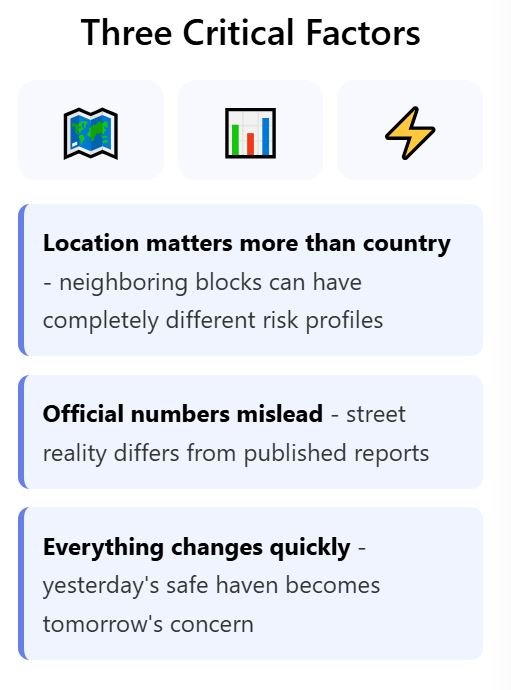
These trends flip faster than international indices can update. Relying on a country’s reputation from five years ago is a strategy that fails. I experienced this environment for 26 years.
If you want an article on my honest impressions of safety in South America—from a local perspective—let me know in the comment section.
Factor Number 5: The Temporal Rift (P-Time vs. M-Time)
You schedule a babysitter for 11 AM because you have some important appointments. She arrives at 2:00 in the afternoon. In the US or Germany, you fire her immediately.
Here, she walks in smiling, acts as if nothing happened, and honestly believes nothing happened. This specific scenario drives more expats back home than politics ever will. Refusing to understand this operating system ensures your failure here.
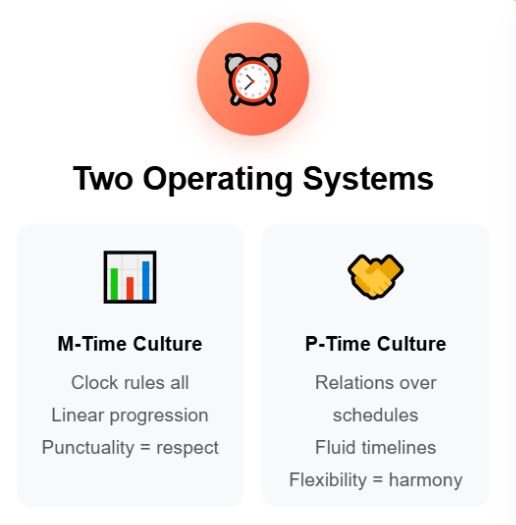
Researchers divide the world into two distinct time perceptions: Monochronic and Polychronic. If you come from North America or Northern Europe, you operate on Monochronic time. Time is linear, scarce, and divisible into billable units.
In your mind, being late is a theft of someone else’s time. South America, however, runs on Polychronic time. Here, the human interaction takes precedence over the clock.
If that contractor ran into an old friend on the way to your house, he stopped to talk. To him, cutting that conversation short to meet a deadline is the rude act, not being late to your house. Robert Levine’s Pace of Life data backs this up.
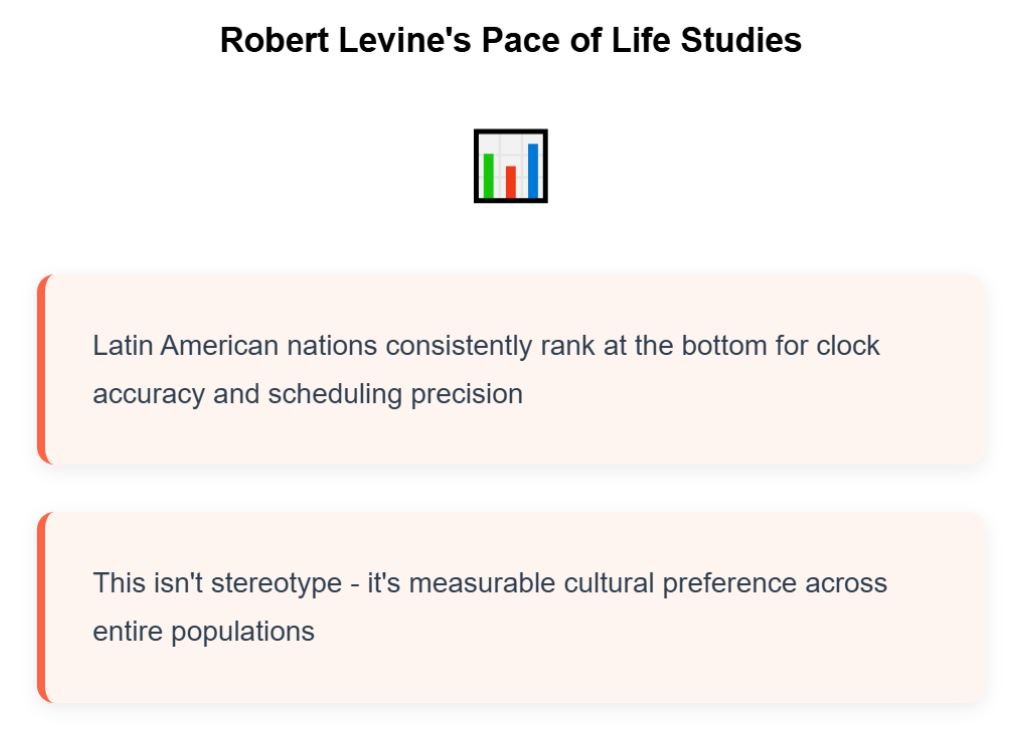
His research consistently ranks countries like Brazil and Mexico at the bottom of global punctuality and accuracy metrics. When you attempt to enforce your Monochronic efficiency standards on a Polychronic culture, you will be fighting a cultural gravity that has existed for a very long time.
Worse is when you interpret lateness as a personal insult. You think the late person is rude, but in reality, he or she just assumed you would understand because, in their world, everyone understands. In South America, time-efficiency is a relationship-centric process rather than a speed metric.
The goal is to keep the social web intact and learn to flow with the local rhythm rather than trying to force the river to run straight. If you cannot make this psychological switch, you will live in a state of permanent anxiety.

4 – The Bureaucratic Labyrinth and Weird Laws
In the US, the legal system operates on the assumption that you are innocent until proven guilty. In South America, this is the same—unless we are talking about your documents, because they are fake until a notary stamps them. The entire administrative framework runs on a baseline of deep institutional distrust.
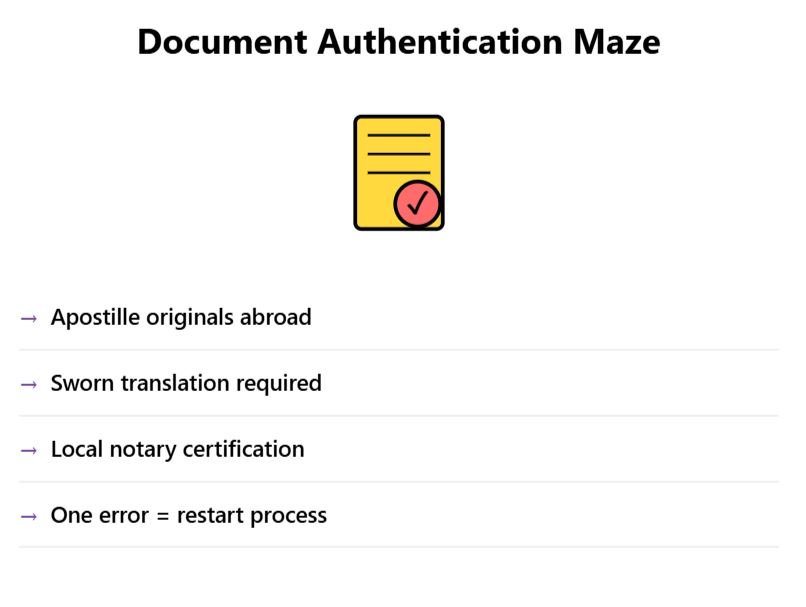
Government agencies do not trust you, they do not trust each other, and they treat digital records with suspicion. You must physically prove your existence for almost every transaction. You might think issuing a certificate in a public office takes twenty minutes on an app.
That is not how it works there. In most South American countries, simple tasks require a stack of paper thick enough to stop a door. Let’s say you want to buy a SIM card or a cellphone number in Brazil; they will require your tax ID.
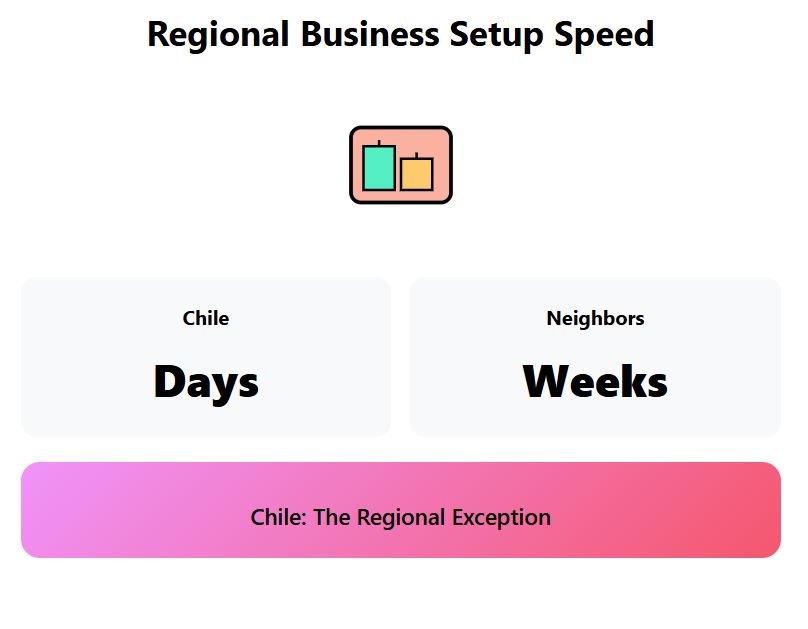
If you are a foreigner, this requirement makes it very difficult for you. Other countries will often require you to prove that you have a local address, though one exception is Chile. For more complex issues, like validating diplomas or birth certificates, you often must apostille the originals in your home country.
You then ask a sworn translator to translate them, and then notarize the final stack at a local office. Let’s look at some metrics. In terms of bureaucracy, countries like Ecuador, Venezuela, Bolivia, and Brazil are statistical outliers on the global stage.
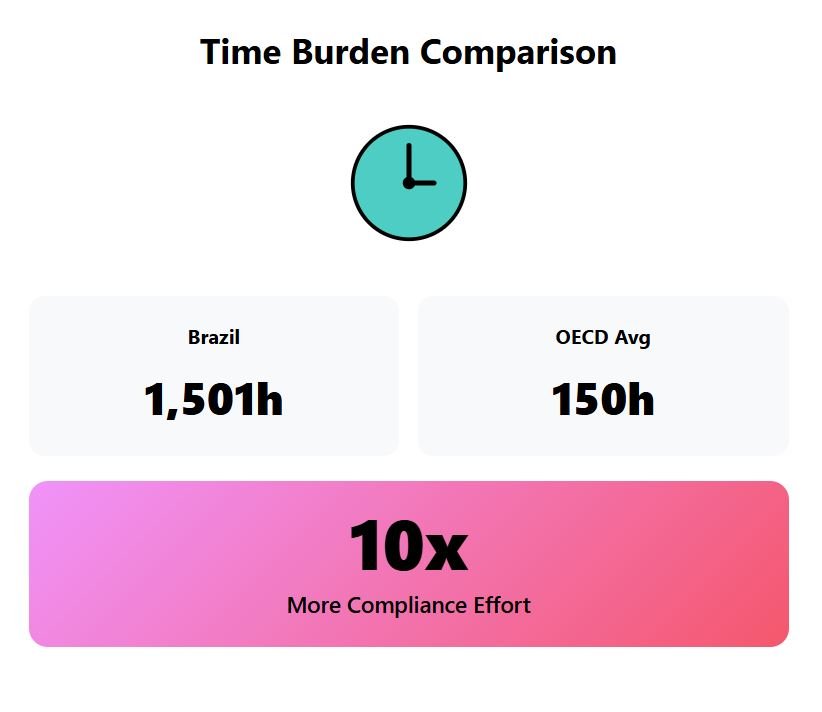
Data shows that companies there require more than 600 hours per year just to comply with tax laws. Compare that to the OECD average of around 150 hours. And this is just one example.
If you plan to work remotely as a contractor or start a small business, this time sink destroys your productivity. Chile stands as the exception in the region. You can set up a business entity there in a matter of days with a streamlined digital process.
But most neighbors lag far behind.
- In Argentina, for example, you face a currency regime so complex it feels like fiction. They have the official rate, the blue dollar rate for cash, the tourist rate for foreigners, and specific rates for exporters.
You lose money instantly if you use the wrong credit card or exchange cash at the wrong window.
- In Brazil, you deal with ICMS. This is a state-level tax that changes rules every time a product crosses a state border.
It creates a web of regulations that even local accountants struggle to track. You must understand that “low cost of living” calculations often ignore this reality. YouTubers categorize countries by the price of rent and groceries.
They fail to subtract the cost of compliance, which can be a massive financial burden.

Then you have laws that change ALL the time.
- Colombia, for example, implemented a wealth tax in 2002. They removed it in 2016, then re-implemented it in 2019, only to remove it again in 2021. Just to implement it again in 2023.
There are also laws that generate weird turnarounds.
- For example, Argentina has strong tenant protections for residential leases, while commercial leases have more pro-landowner eviction rules. So owners sometimes sign contracts calling the apartment an “office” even if the tenant sleeps there. If the tenant later can’t pay, the owner argues it’s a commercial contract so they can evict faster.
All these laws and bureaucracy often force you to hire someone to help you. In the US or Europe, you might take pride in filing your own taxes or handling your own visa application. But in South America, “Do It Yourself” is often a trap.
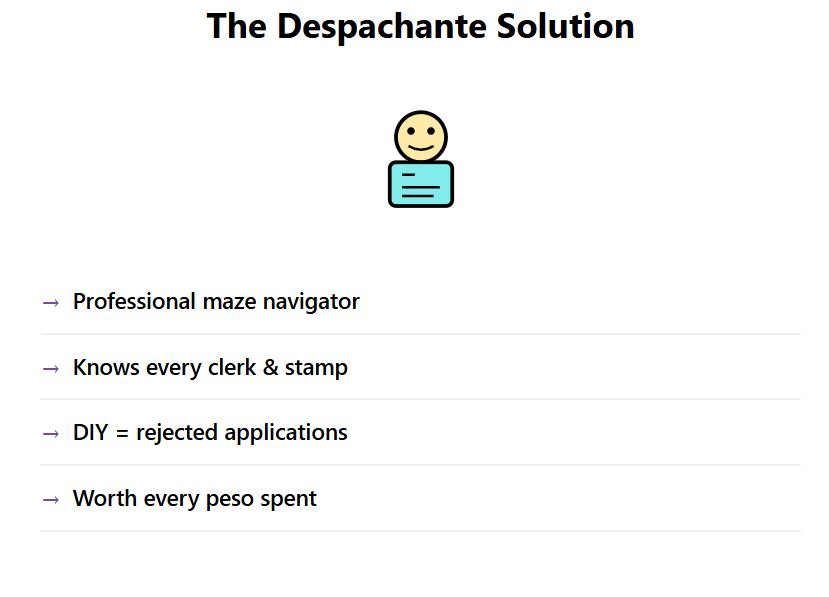
That is why in some countries there is the service of the “despachante”: someone who knows exactly which clerk to speak to and exactly which stamp goes on which line. You pay them to navigate the maze for you. And navigating this bureaucracy is impossible if you cannot communicate with the people running it.
3 – The Language Isolation Trap
There is a dangerous myth that ‘everyone speaks a little English’ in big South American cities. You might assume that because American culture is everywhere, you can get by with a smile and a translation app. This assumption is the fastest way to isolate yourself.
The reality is that outside of specific bubbles, English proficiency is statistically nonexistent. You need to look at the data to understand the scale of this barrier. The EF English Proficiency Index ranks countries based on test data, and the results for South America are sobering.

Countries like Brazil, Colombia, or Ecuador are considered to have low proficiency. In practical terms, estimates show that less than 5% of the population is fluent. This applies to the entire workforce.
Even in major capitals like Bogotá or São Paulo, expecting English service in hospitals or government offices is a mistake. The clerk at the notary office probably will not speak English. The police officer at the checkpoint does not speak English.
The nurse checking you in at the ER does not speak English. This creates a financial penalty that I call the “Gringo Tax.” Because you cannot navigate the market yourself, you become dependent on intermediaries.
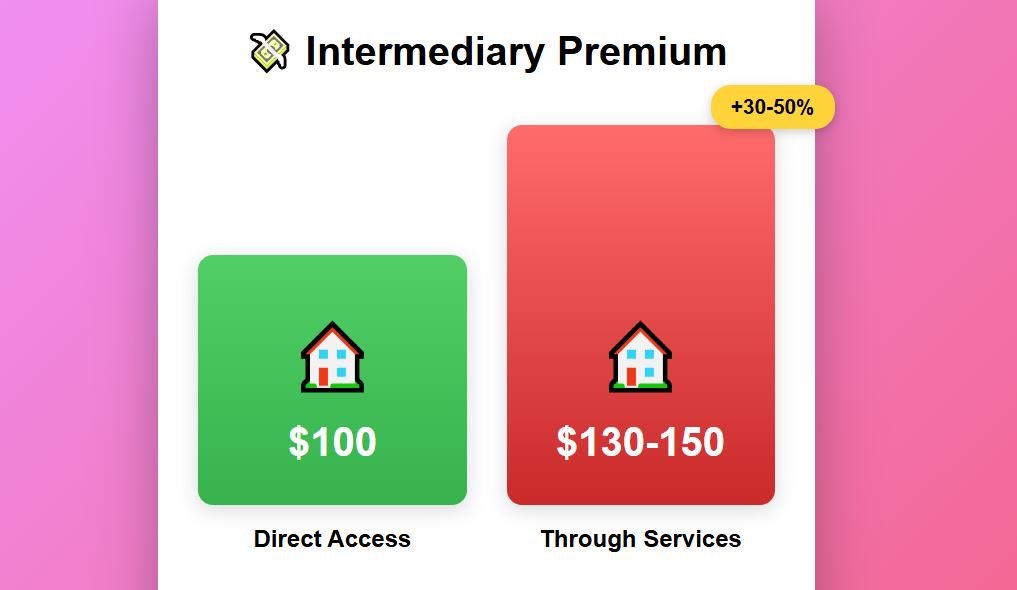
If you want to rent an apartment, buy a car, or negotiate a contract, you will need to pay an agency to do it for you. You often pay 30% to 50% more for your lifestyle than a local does, simply because you are restricted to the “English-speaking tier” of the economy. The social cost is just as high.
Without the language, you become socially isolated. You get trapped in a bubble of other expats. I saw this happen.
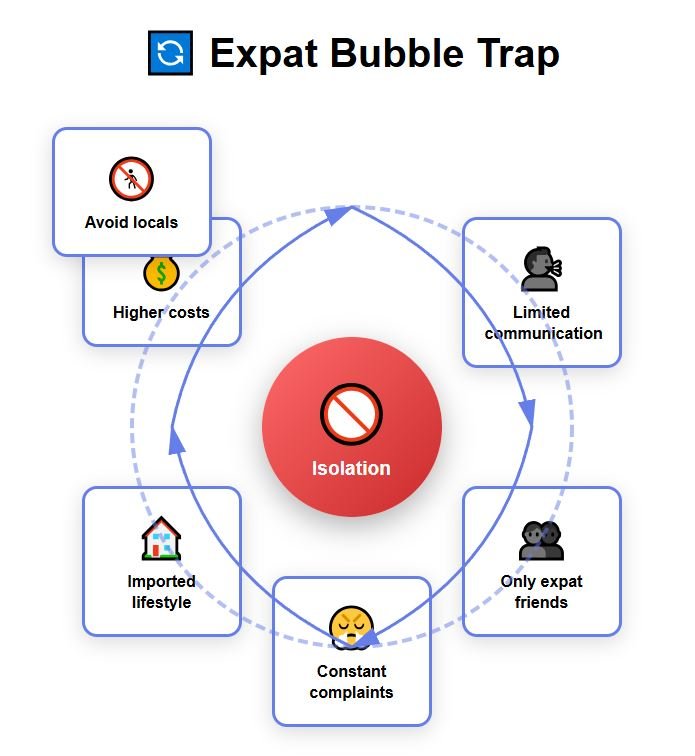
You end up spending all your time with retirees from Florida or digital nomads from the UK. You sit around complaining about how inefficient the country is, never realizing that the inefficiency is partly due to your inability to communicate. You never truly live in South America; you live in an imported simulation of it.
Imagine you have a water leak in your kitchen on a Sunday and call a plumber. He arrives, but you cannot explain that the leak only happens when the washing machine runs.
He stares at you; you stare at him.
You try to mime the problem. He fixes the wrong thing. You pay him anyway. You still have a leak.
And sorry to say, but Google Translate does not always work—in fact, even when it works, it does not really “work”. In countries like Chile, Argentina, or Brazil, there is so much slang that translating apps might actually fool you.

Without the language, you are permanently a tourist, paying tourist prices for a surface-level experience. The only way to stop paying this tax is to actually learn the language. And honestly?
Spanish and Portuguese are two of the most fun and accessible languages to learn—if you use the right method. And I have a special weapon to learn languages: Lingq immerses you in content you actually enjoy, rather than boring grammar drills, making the process natural.
But after you speak the language perfectly, there is still the next obstacle.
2 – The Healthcare Age Cliff
Healthcare in most of South America is a tale of two systems. It is world-class if you can pay for it, and collapsing if you cannot, with almost no middle ground. If you have the money, private hubs like Hospital Albert Einstein in São Paulo rival the best facilities in the US.

You get private rooms, state-of-the-art equipment, and English-speaking specialists—but it is expensive. On the other side, relying on the public system often means long waits and resource shortages. You might wait months for a simple specialist appointment.
The real danger for retirees is the “Age Cliff” written into many private insurance contracts. After age 60, private plans often become prohibitively expensive. Suddenly, your pension doesn’t cover your premiums, and you are left exposed.

See this example of an ordinary private healthcare provider: A 48-year-old person pays US$186 a month, while a 60-year-old person pays US$402. Quality care is also geographically constrained to a few major metropolitan areas.
In Colombia, for example, ALL the 10 best private hospitals are distributed among just 3 cities: Bogotá, Cali, and Medellín. A similar situation we see in other countries. If you choose a quiet beach town to retire in, you are likely hours away from a stroke-capable facility.
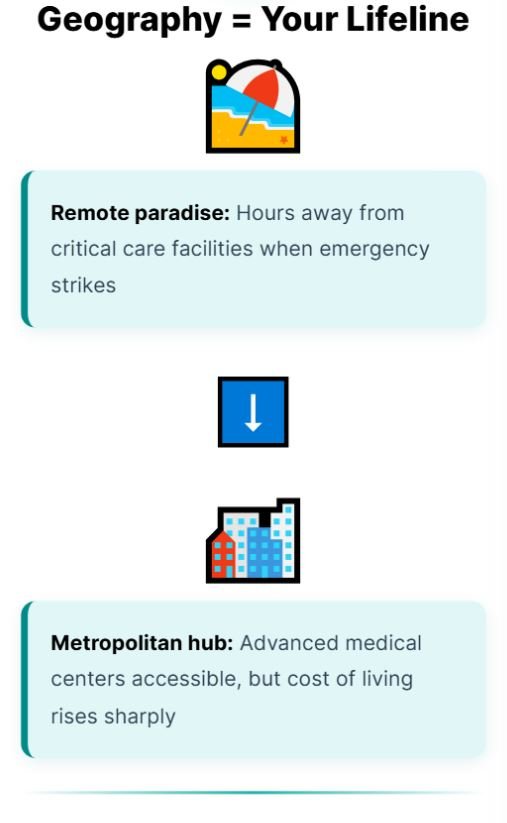
You cannot just assume an ambulance will reach you in time on a dirt road. And moving around this continent might be harder than you think—which leads us to our next issue.
PS: My Expat Wealth & Lifestyle Compass (valued at $108) is yours FREE for a limited time! Receive our 74-page analysis of affordable cities in Spain, Italy, and France; our guide for Zero-Income Tax countries that can save you up to $15,600; and the checklist that prevents costly mistakes. Don’t let your chances go away-join us for free!
1 – The Tyranny of Distance
Looking at a map, you might think a weekend trip to another country is easy. After all, they have the Mercosur, which is like a European Union of the South where you can travel from one country to the other, right? Right?
The answer is no—not even close. The scale of South America is deceptive and the connectivity is shockingly poor. The Mercator projection creates an optical illusion that shrinks the true size of the equator-hugging nations.
You are not going to a compact zone like Europe where a two-hour train ride changes the language and culture. You are entering a massive territory. The vertical scale implies distances that sound impossible until you verify them.
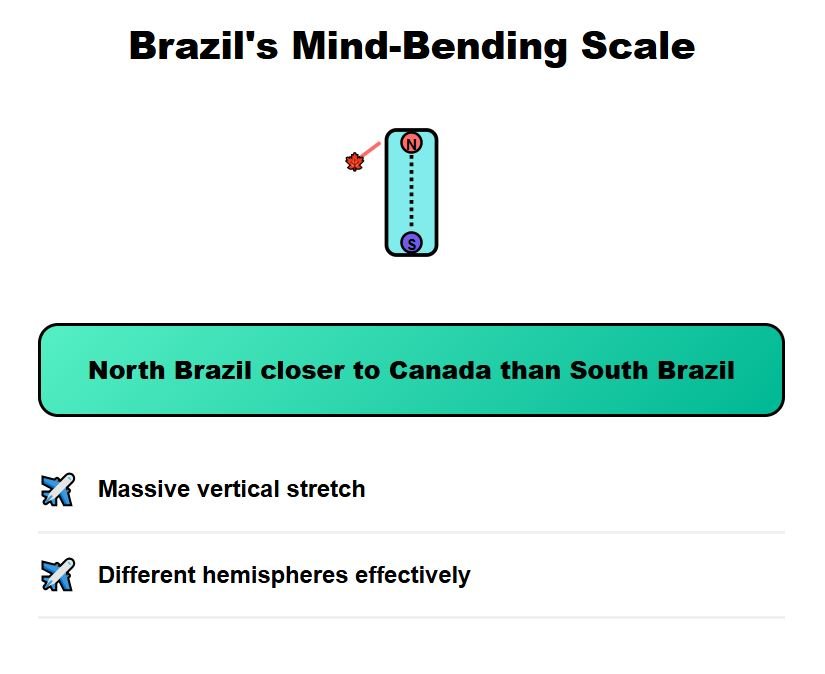
One example: The North of Brazil is actually closer to Canada than it is to the South of Brazil. That is not a typo. The distance from the northern border to the southern tip of the country exceeds the distance from that same northern point to the Canadian border.
Consider air travel—a direct flight from São Paulo to Bogotá covers 4,327 kilometers. It is more than a flight from Iceland in Europe to Boston or New York in the US. Now add the friction of international borders, slower customs processes, and less frequent schedules.
Also, airports in this part of the world are not among the best, saying from my own experience. You do not simply pop over to Colombia for a weekend trip like in Europe. It is a major logistical commitment that drains both your wallet and your energy.
This fact destroys any concept you have of ‘local’ travel. When you live in the south, the north is effectively a different hemisphere. Since you likely cannot fly everywhere due to cost, you might look for a train.
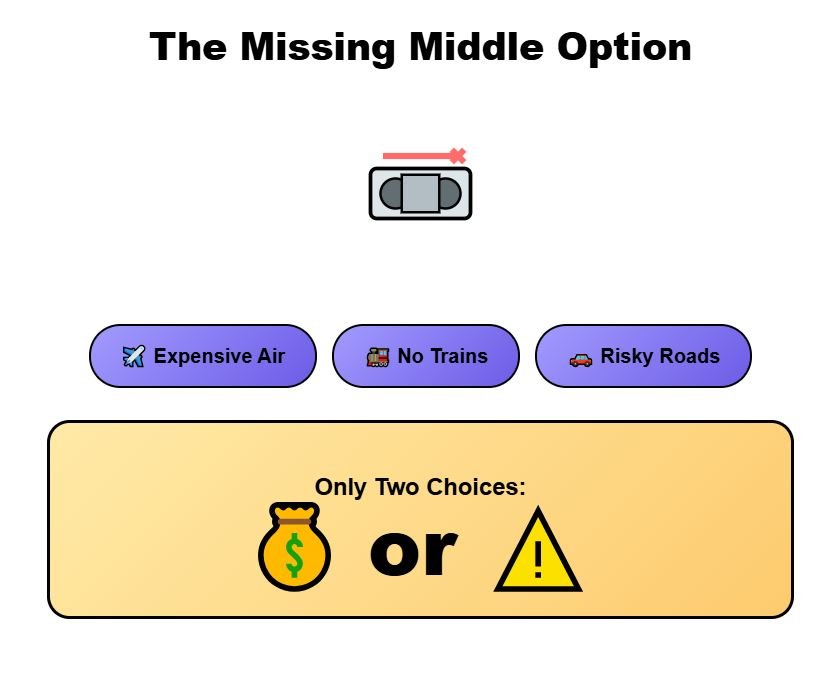
You will not find one. There is almost no passenger rail network on the continent. This infrastructure gap forces you onto crumbling roads or expensive domestic flights.
You have no middle option. You either pay a premium for air travel or you risk your safety on the highway. The driving conditions add another layer of friction.
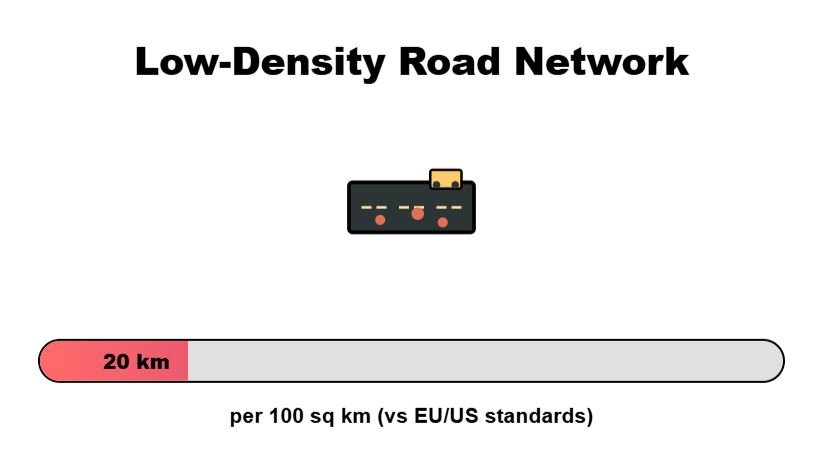
Road density in South America hovers around 20 kilometers per 100 square kilometers, which is far below US or European standards. This creates bottlenecks. You often depend on a single main artery to connect vast regions.
If a landslide blocks that road, entire cities get cut off. You share these narrow, often potholed strips of asphalt with aggressive cargo traffic. It is stressful and dangerous.
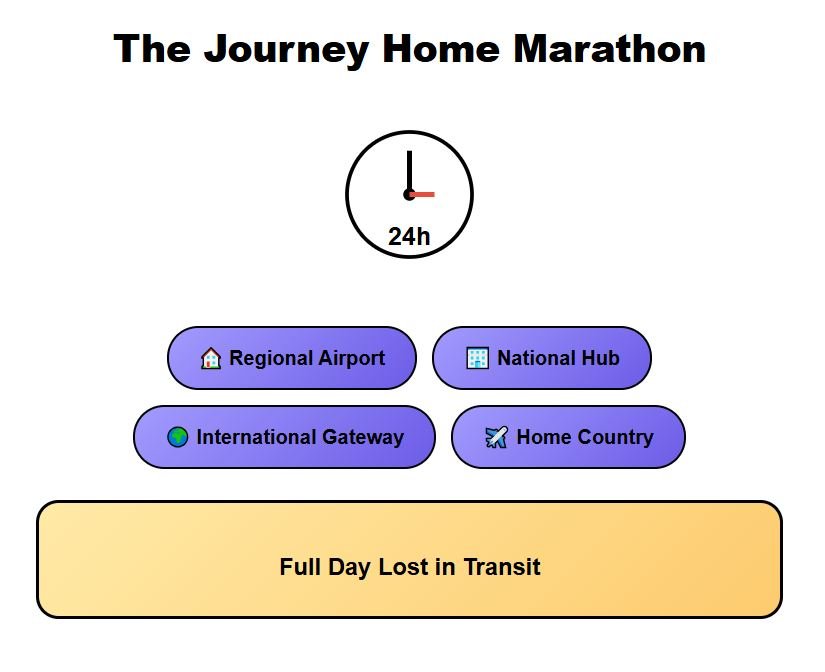
This isolation hits hard when you plan to visit family back home. It becomes a logistical marathon involving multiple connections. You bounce from a regional airport to a national hub, then to an international gateway, and finally to your home country.
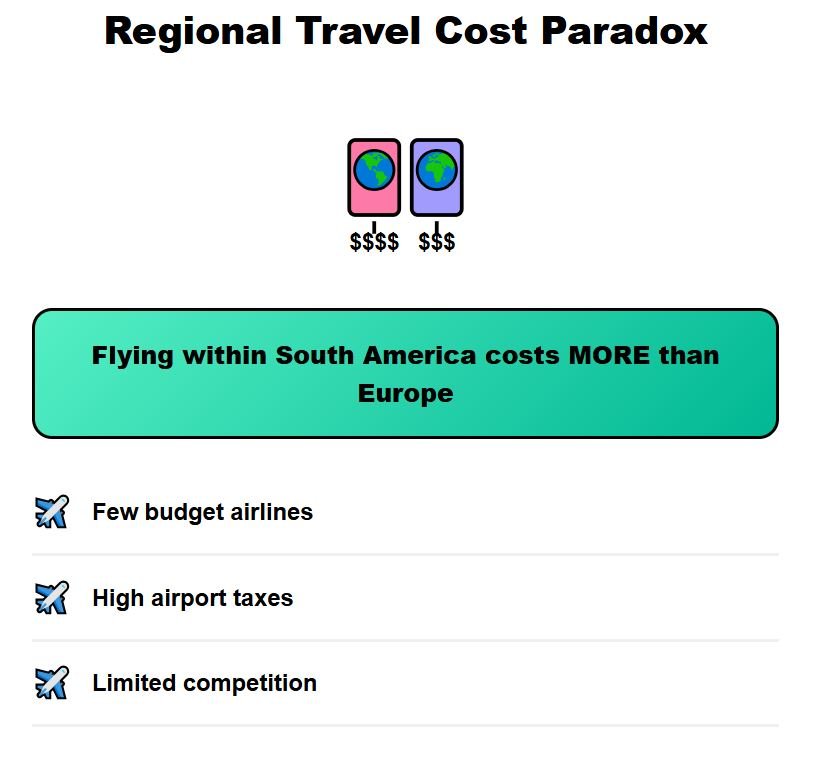
By the time you arrive, you have lost a full day. Regional travel within South America often proves more expensive and time-consuming than flying to Europe. The lack of budget airlines and high airport taxes distort the market.
You must accept that travel here requires significant planning and patience. It is not a casual activity.
But don’t get me wrong—South America also has many positive things.

It is not just a cheaper version of Florida, but a distinct operating environment. Success there specifically requires accepting the local time, mastering the language, and, well… tolerating the bureaucracy (or avoiding it when you can). If you prepare for these realities, the continent offers an incredible life.
If you ignore them, you will be on a flight home in a matter of months. And if you want to know exactly where that incredible life is waiting for you, in one of my most important articles EVER, I ranked the BEST cities in South America to move to.
And join my Patreon for all the sources and charts from our articles, plus a chat, so I can answer your questions. Tier 2 includes all my eBooks on living and retiring abroad-scan the QR code today!
Levi Borba is the founder of expatriateconsultancy.com, creator of the channel The Expat, and best-selling author. You can find him on X here. Some of the links above might be affiliated links, meaning the author earns a small commission if you make a purchase.