Imagine waking up in your new country… and realizing the supermarkets are empty.
I’ve spent years helping hundreds of expats find the best places to live, and that experience is exactly why I need to warn you about what I’m seeing now.
Here I will show you 5 countries to avoid in case of a WWIII
We’ve entered a fragile era where danger is not only close to war zones. It’s about supply chains. It’s about food. It’s about fuel.
Think about it:
- What good is a luxury penthouse in a wealthy country if 90% of your food comes through a single shipping route that gets blocked — maybe for months?
- What happens when a booming desert metropolis relies almost entirely on vulnerable desalination plants just to keep the tap water running?
- Or when the most peaceful country in Europe is just a few hundred kilometres from the biggest war in the continent since World War II and its internet can be cut overnight due to foreign sabotage?
These aren’t obvious danger zones — almost no one will alert you about them. Because the best countries during peaceful times can become traps during times of conflict.
And when you see which five countries made this list, at least two of them will surprise you.
The Criteria
We used five data-based factors to measure your safety in case of conflict.
First is Geostrategic Proximity — how close you are to war zones and the risk of drone hits. Second is Resource Sovereignty — how much food and water a country imports. We also look at Critical Infrastructure — this includes the security of power grids and internet.
And here is something most people ignore, but that I discovered first-hand since I live in one of the countries I will list today: in case of conflict, the internet and cellphone signal are the first things that go down. Hostile countries will cut internet cables, and if you rely solely on credit cards or electronic payments, you will not even be able to fuel your car.
Another factor considered is Social Stability — this shows when internal unrest is a major risk. Finally, we check Evacuation Viability — can you leave by land, or are the airports and seas blocked?
5th Place: Germany
Germany lands at number five, and this might surprise you because it’s wealthy and stable on the surface.

Germany’s government collapsed in late 2024, and the snap elections in February 2025 didn’t fix anything. The new chancellor won, but barely. The political stability index dropped from 0.87 down to 0.12 in 2024. When a country’s political institutions are that shaky, civil unrest spreads faster. And if you’re an expat without deep local connections, you become visible during unrest.
More polarization means less social cohesion. When a crisis hits, people don’t pull together — they fracture further. This directly impacts your personal security as a foreigner.
Now let’s talk about the real problem: Germany is building an enormous military while ignoring civilian safety. In March 2025, they passed a one trillion euro spending bill for tanks and weapons. But civil defense infrastructure is lagging badly. There are almost no modern shelters for regular people.
When a NATO-scale conflict happens, civilians become targets for cyber attacks and hybrid warfare. Germany’s power grid is particularly vulnerable. They shut down their nuclear power plants years ago. That decision created a dangerous dependency. The country now relies heavily on energy imports from neighboring countries.
If those imports get cut off — whether by conflict or sabotage — the lights don’t just flicker, they go dark. The grid itself has another problem: it’s built for centralized fossil fuels, not the wind and solar power Germany is now trying to run on.
Add in the fact that hostile state actors are already targeting German internet cables and power infrastructure, and you’ve got a system that can fail in multiple ways at once.
Foreign investment in Germany’s industrial heartland has collapsed. A 90 percent drop in foreign direct investment hit the chemical sector specifically. Companies are pulling money out, not putting it in — signals that major investors see risk ahead. When businesses flee, the economy contracts, and if the economy contracts during a conflict, everything gets worse faster.
Cyberattacks are a reality lately. Internet cables get cut. Power surges happen. The government itself is racing to meet a July 2026 deadline for the KRITIS law, which requires minimum security standards across all critical infrastructure.

Here’s where Germany has one advantage over countries on this list — evacuation. You can drive out. Germany has land borders with the Czech Republic and other countries. You’re not trapped on an island or in a desert.
But if the power goes out for weeks, sitting in a cold German apartment in winter without heat becomes life-threatening. Your high taxes don’t buy you a functioning civil defense system.
The geopolitical risk score for Germany is 55.8 out of 100. That’s elevated danger. It’s the safest of the five countries on this list, but only because the others are in a far worse situation. Germany is still a serious risk if conflict escalates.
4th Place: Turkey
Turkey is a frontline state, and that changes everything about your safety calculation. It’s affordable, the food is good, and expats love it there. But Turkey touches multiple active war zones.
In early 2026, Turkish authorities confirmed that at least three missiles from Iranian territory crossed into Turkish airspace — not by accident. They were targeting assets further west, which means Turkey is in the middle of a conflict it didn’t start.
The geopolitical position is what experts call threshold management. Turkey has to balance NATO obligations against critical energy ties with Russia and Iran. That balance is getting thinner every month.
The Baku-Tbilisi-Ceyhan pipeline runs through Turkey, and that infrastructure makes it an attractive target for proxy attacks. Hostile actors can disrupt global energy markets without directly attacking a NATO country.
So what’s Turkey doing about it? The government boosted defense spending by 30 percent — that’s $27.34 billion in 2026, or 2.33 percent of GDP. They’re building the KAAN fighter jet and the Steel Dome air-defense system. But current air defense capabilities are stretched thin across Turkey’s vast borders.
The military gets the new hardware. Civilians get nothing.
This became obvious in early 2026 when those Iranian missiles hit. The government realized the civil defense system was broken, so they launched a nationwide bunker construction project across all eighty-one provinces. But this is reactive, not preventive — they’re building shelters after missiles already landed on Turkish soil.
The real issue is older than that. Turkish building codes from 1987 required shelters in large residential and commercial buildings. Developers ignored those mandates for decades, converting underground spaces into parking lots and retail shops. Now the government is scrambling to fix what should have been done thirty years ago.
The civilian protection network is inadequate for a large-scale escalation. Dense urban populations are acutely vulnerable to aerial or ballistic threats. That’s your reality as an expat in Istanbul or Ankara.
But military vulnerability is only half the problem. The economy is the other half. Turkey’s growth is projected at 3.5 to 3.8 percent in 2026, but that’s constrained by high borrowing costs and declining real incomes. The nation has substantial external debt and massive short-term refinancing needs. If global liquidity shifts or investor sentiment changes, the financial system locks up.
If conflict spills over the border, the financial system could freeze your access to cash overnight.
Small and medium-sized enterprises are already struggling under tight credit conditions. Corporate insolvencies are rising in construction, retail, and manufacturing. The economy is fragile before any conflict even starts.
Expatriates in Turkey also lack the local social networks that Turkish citizens have. You don’t have family in the countryside who can supply food if the supply chains break. When a prolonged supply chain cutoff happens, locals survive through family networks. You don’t have that option.
3rd Place: The Philippines
The Philippines is becoming the central maritime theater for great-power competition between the US and China. The South China Sea holds about 11 billion barrels of oil and 190 trillion cubic feet of natural gas. That’s what the fight is actually about. And the Philippines is right in the middle of it.
Retirees love the Philippines. The cost of living is cheap, the beaches are splendid, the food is tasty. But the geography is a trap, and most people don’t see it until it’s too late.
You’re on an archipelago. That means you’re surrounded by water. Water that’s contested. Water that can be blockaded.
China is already testing the boundaries. The People’s Liberation Army Navy and Chinese Coast Guard are constantly running gray-zone tactics near the Scarborough Shoal and the Spratly Islands — ramming civilian supply boats and deploying military water cannons against Philippine naval vessels. This is happening right now, not in some distant future scenario.
The 2016 International Tribunal ruled against China’s claims. Beijing ignores it. They assert historical sovereignty and back it up with force.
The Philippine government signed a mutual defense pact with the United States. Then they signed a Reciprocal Access Agreement with Japan. This allows foreign military forces to operate in Philippine territory and share logistics. It makes the Philippines a direct participant in any superpower conflict.
The State Department maintains a Level 2 travel advisory for the entire country because of crime, terrorism, and kidnapping. Specific regions have Level 4 “Do Not Travel” warnings: the Sulu Archipelago, parts of the southern Sulu Sea, Marawi City in Mindanao. Organized groups actively kidnap foreign nationals for ransom. It happens. Political protests can escalate into violence without warning. Local law enforcement can’t respond fast enough.
Now imagine a naval blockade. China closes the ports. Airspace gets restricted. You’re trapped on an island where you can neither fly nor sail out. The archipelagic geography makes mass evacuation nearly impossible.

Foreign expats would be competing for whatever limited routes remain. The Philippine Department of Foreign Affairs has a crisis alert system, but it’s designed to bring home Filipino workers from conflicts abroad — not to extract foreign nationals trapped inside the Philippines.
The Philippines depends on maritime trade for fuel and food. A blockade cuts those supply lines immediately. Shortages happen fast in dense urban areas. Manila has massive expatriate populations. They have money in banks that might freeze. They have credit cards that might not work. They have no local family networks to fall back on.
When the supply chains break, locals survive through relatives in the countryside. Expats don’t have that option.
The geopolitical risk score for the Philippines is 79.7 out of 100. That’s the second highest on this entire list.
China keeps militarizing the waters. The US and Japan keep strengthening their presence. Diplomatic efforts exist, but they’re overshadowed by what’s actually happening on the water. The Philippines transforms from a tropical paradise into a series of isolated, unsupplied islands if conflict escalates.
2nd Place: Poland
Poland spends 5 percent of its GDP on the military. That’s the highest in all of NATO. No other country comes close — the US spends 3.5% and Germany spends just 2.6%. Poland is spending more than double what most allies put toward defense.
That massive commitment came because Poland borders Ukraine. The government is building toward 300,000 active-duty soldiers and 200,000 high-readiness reserves. They’re planning for a long, grinding war that could happen on Polish soil.
This is preparation for occupation and prolonged conflict. The Armed Forces Development Program runs through 2039. Poland is betting that the next fifteen years will be defined by warfare.
But here’s what most people don’t see. That money for tanks and soldiers comes directly from somewhere else. Healthcare gets cut. The National Health Fund loses resources. Poland already has some of the lowest life expectancy rates in the entire OECD. People die younger here than in other rich countries.
Spending 5 percent on military means less money for hospitals, doctors, and medicines. That trade-off happens while the population is aging — you need more healthcare resources as people get older, not fewer.
There’s also a labor problem. Conscripting 500,000 people into a military force drains the civilian workforce. Construction, factory, and care workers all become soldiers. The economy shrinks from the inside out because the people who build things are now training for war.
Now here’s where Poland gets an advantage over most places on this list. Poland has a food self-sufficiency rate of 75.5 percent. If the global supply chains break, Poland doesn’t starve. Compare that to the UAE, which imports 90 percent of its food, or the Philippines, which depends on maritime routes for everything.
Poland also has evacuation routes. If things get bad enough, you can leave by land to Germany or cross into the Czech Republic.
But none of this solves the immediate problem. Poland is on the front line of a hybrid war that’s already happening. In September 2025, waves of drones crossed into Polish airspace from Belarus. Internet cables get cut. The government admitted this. Telecom services go down. It happens multiple times a year.
If your entire life depends on digital payments and cloud services, you’re vulnerable when the cables are severed.

Heating is critical in Poland. Winters are brutal. If heating fuel becomes scarce or rationed during a conflict, you’re sitting in a cold apartment.
The government is distributing safety handbooks to every household — telling people how to prepare for air attacks and chemical threats. That’s not the sign of a safe country. That’s the sign of a country preparing for war.
Railway sabotage has happened multiple times in recent months. Sleeping cells of hostile operatives have been discovered operating inside Poland — a threat that is real right now.
Poland has food security and evacuation routes. But it’s also the shield of Europe, and shields take hits.
1st Place: The Country Most Vulnerable to Conflict in 2026
Dubai and Abu Dhabi look like the future. The skyline is stunning. The infrastructure works. The weather is warm year-round, taxes are virtually zero. For retirees and remote workers, it seems perfect.
Except it’s built on sand in a desert with almost no natural resources.
Almost every vegetable, every grain, every piece of meat comes in through ships. The country could not feed itself for more than a few weeks if those ships stopped coming. Strategic food reserves last three to six months maximum — and after that, the situation becomes critical very quickly.
Where does the water come from? Forty-two percent of drinking water comes from desalination plants. These plants sit right on the coast. They’re vulnerable. Drones hit targets in the Middle East all the time now. A single missile or drone strike on a major desalination plant would cut off drinking water for hundreds of thousands of people.
In March 2026, Iran effectively closed the Strait of Hormuz. Tanker traffic dropped by more than 90 percent within days. That’s what happens when a chokepoint closes. The Strait of Hormuz normally handles 20 to 27 percent of all global seaborne oil and 20 percent of global LNG exports. It’s the most critical shipping lane in the world.
If it closes, the UAE is under a double blockade. Ships can’t get in from the east through the strait. They can’t get in from the west through the Red Sea and Bab el-Mandeb because that route is also contested. You’re trapped with no food, fuel, or supplies coming in at all.
Maritime insurers have already withdrawn coverage from the region. Roughly 10 percent of the entire global container fleet got stranded when the strait closed. Ships and captains won’t risk the journey, and insurance companies won’t cover it. This happened in real time in 2026.
Private evacuation sounds good in theory — you’re wealthy, you hire a jet, and you leave. But if the airspace gets restricted, commercial airlines cancel flights immediately. The threat of missile interception is real. Airlines pulled out.
Now you’re sitting in a luxury penthouse with no way to leave. No airport access. No commercial flights.
The overland routes don’t exist. You can’t drive to another country from the UAE. You’re surrounded by water on three sides and Saudi Arabia on the fourth. If Saudi airspace closes too, you’re stuck.
Your high-end health insurance probably has an act-of-war exclusion. That means if you get injured during a conflict, your insurance becomes worthless. You paid thousands in premiums and they pay zero. You’re uninsured in a desert with no water and no way out.
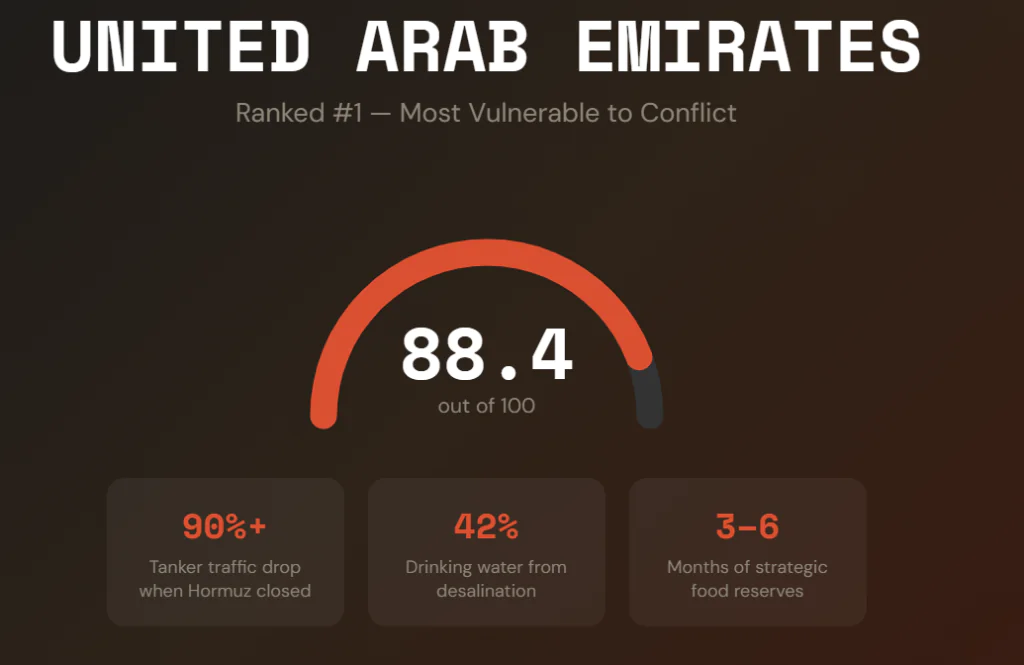
The geopolitical risk score for the UAE is 88.4 out of 100 — the highest on this entire list. Higher than Poland. Higher than the Philippines. The infrastructure is world-class, but it’s completely dependent on supply chains that can be cut instantly.
Modern infrastructure doesn’t equal survival.
Now, one way to isolate yourself from world food disruptions and protect yourself against crisis is to own a farm — and that is why we also ranked the best and cheapest places to buy farmland in Europe.
And join my Patreon for all the sources, charts, and maps from our articles, plus a chat, so I can answer your questions. Tier 2 includes my top three eBooks on living and retiring abroad—scan the QR code today!
Levi Borba is the founder of expatriateconsultancy.com, creator of the channel The Expat, and best-selling author. You can find him on X here. Some of the links above might be affiliated links, meaning the author earns a small commission if you make a purchase.