If you’re choosing where to retire in South America by asking “where is rent cheapest?” you are asking the wrong question. Rent is not what sinks a retirement here. Currencies do. Taxes do. Politics does. And here you will discover how much you need to retire in South America.
In one country, local prices rose just 1.5% in a year – they have less inflation than the US! Yet for you, arriving with dollars, life there got almost 33% more expensive.
In another, local inflation was 40%, but for you, it got cheaper, and you will discover about it further in this article.

In my 26 years living in South America, I’ve seen economic and tax changes do more damage to a retiree’s budget than any landlord ever could. I’ve watched retirees who did everything right have to move back home for this.
So I built a model to answer one question: How much do you need invested to live a good life in each country in South America indefinitely, without ever touching the principal?
Ten countries. October 2026 prices. Taxes included. By the end of this article, you’ll know your number, and which country gives you the most life for the least money.

Let’s start with the criteria.
The Criteria
The model assumes you have a diversified investment portfolio returning 7% per year on average. But you can’t spend all of it.
Part of that return has to protect your money against inflation, which we assume at around 4% per year in dollar terms. That leaves 3% per year – our withdrawal rate, or the share of your investments you can spend each year without consuming your principal.

Then we take the cost of a comfortable but not extravagant life in a representative city in each country.
The budget is for a single person: a furnished one-bedroom apartment in a good neighborhood, private health insurance, groceries, utilities, transportation, and an entertainment budget with eight restaurant meals, twenty beers at a local pub, and a gym membership every month.

Prices are from October 2026, in US Dollars, combining each country’s local inflation with what its currency did against the dollar. If the local currency got stronger, everything got more expensive for you, even if local prices barely moved.
And that completely reshuffled the ranking.
Then we consider taxes, because some countries will not tax you at all. And from that, we calculate the income needed for that country, and the amount you need to invest to achieve that income.

Let’s see the results, starting with the most expensive.
#10 – Maldonado, Uruguay: The Price of the Riviera
We start with a quiet coastal city in Uruguay, right next to maybe the most famous beach resort in South America.
This is Maldonado, a city with 102,000 people on the Atlantic coast about 130 kilometers – 80 miles – east of Montevideo. Its neighbor is Punta del Este, and plenty of people who say they live in “Punta” actually live in Maldonado.

Housing is what puts it in the last place. A good one-bedroom apartment costs $843 a month, the highest rent on our list. Add $975 for all the other expenses, and you reach $1,818 a month.
Last year, Uruguay was the most expensive country, and this year it kept the same place: the cost of living in dollars rose only about 5.4%.

Taxes, on the other hand, are zero. New residents get an 11-year tax holiday on foreign dividends, interest and capital gains.
The change is that since January 2026, you need to spend more than 183 days a year in the country to qualify for this tax holiday. After year eleven, there’s a transition at 6%, and then the standard 12% applies.
With no taxes, you need a gross income of almost $22,000 a year, which means you need $727,000 invested to retire in Maldonado. It is the only city on our top 10 where you need more than $700,000 invested.

What you get for that money is stability. Uruguay is so stable that it does not even look like Latin America.
Homicides nationally rose in the first half of 2026, but robberies fell. In Punta, robberies during the last summer season dropped from 70 to 23.
Montevideo’s airport is about an hour and a half away by car, with nonstop service to Miami and Panama City, in Central America.
And talking about Panama, we are considering making a similar article about Central America and Mexico.
#9 – Florianópolis, Brazil: The Island With a 15% Toll
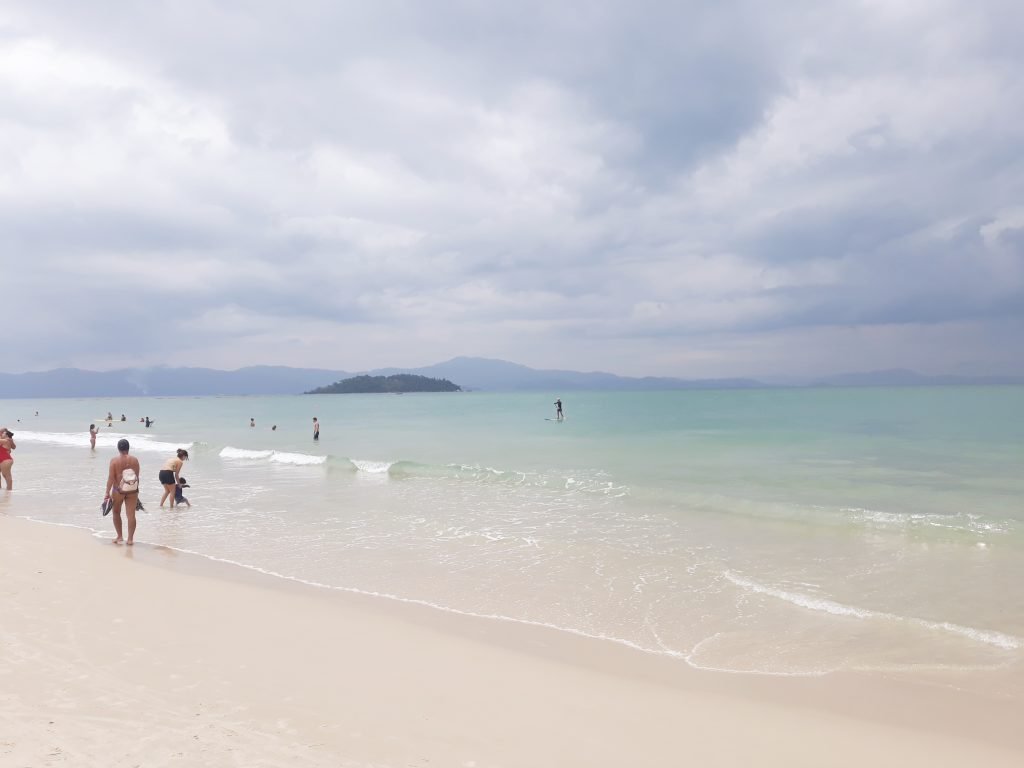
Number 9 takes us to Brazil, to a city built mostly on an island. Florianópolis – “Floripa,” as Brazilians call it – is the capital of the southern state of Santa Catarina.
Around 540,000 people live there, and it has become one of Brazil’s main tech hubs. Personal note: I spent my honeymoon there.

Rent is on average $559 a month and other expenses add $764, for a total of $1,323. In July 2025, that same lifestyle cost $1,172.
What hurt your budget was the real, which strengthened from 5.53 to 5.14 per dollar. In dollar terms, Florianópolis became almost 13% more expensive.
Then come taxes. Since 2024, Brazil taxes financial investments held abroad at a flat 15%, with no tax-free allowance. On the income you need, that’s $233 every month.
The required gross income is about $18,700 a year, or almost $623,000 invested.

Florianópolis has a reputation as one of the safest state capitals in Brazil. The bigger risk right now is that Brazilians vote on October 4 in a polarized presidential race between Lula and Flávio Bolsonaro.
Elections in Brazil tend to move the currency – and the currency is exactly what moved your cost of living this year.
There are no nonstop flights to the United States, you connect through São Paulo.
#8 – Valencia, Venezuela: A Complicated Case
And here is a country difficult to talk about… Venezuela!
The city we analyzed is Valencia, the country’s third-largest municipality with 1.6 million residents.
In July 2025, Valencia was the cheapest city on our list, with a cost of living of just $730 a month. Today, the same budget costs $1,027 – nearly 41% more.
In Venezuela, taxes hit hard. Venezuela taxes residents on worldwide income, and the top tax bracket (34%) is achieved with a mere $300 a year of income!
In other words, anyone living on investment income is in the top bracket. So you might end up paying more in taxes than in rent.
Will Venezuela properly collect taxes on all your worldwide investments? Probably not – it is a failed state, so they cannot even monitor that properly.
The cost of a single person is $18,600 a year, so you need $620,000 invested – only $3,000 less than Florianópolis, for a considerably worse quality of life.
The political picture changed dramatically in 2026. In January, a U.S. military operation captured Nicolás Maduro, and Delcy Rodríguez took over as acting president.
Oil sanctions were lifted, and the U.S. embassy reopened at the end of March. But no election has been scheduled, and the same state apparatus is still in place.
Violence and power outages are still a risk.

One of the few good news is in terms of airline connectivity. American Airlines restarted flights between Miami and Caracas in April 2026, the first in seven years, and now flies twice a day.
There are still no passenger flights from the U.S. to Valencia itself, so you’ll drive about two and a half hours from Caracas’ airport.

#7 – La Serena, Chile: The Big Coast, Narrow Countryside
Here we go all the way to Chile. I lived there, in Santiago, but I will not talk about Santiago, because nobody would move to retire in such a huge and expensive city. Unless you really enjoy seeing skyscrapers all around.
Instead, we go to Chile’s second-oldest city, next to the Elqui Valley and its famous astronomical observatories.
La Serena is 300 miles north of Santiago, and has 250,000 residents. Together with the port of Coquimbo next door, it forms an urban area of around half-a-million people.

Rent is on average $526 a month, and other expenses add $889, for a total of $1,415. That second number is high mostly because of healthcare: $231 a month.
The cost of living rose about 5% in one year.

The low taxation is one of the high points of Chile. Foreign residents don’t pay tax on foreign income during their first three years in Chile.
After that, the first 11.3 million pesos a year, about $11,900, are exempt, and the next bracket pays only 4%.
To make enough from investments to retire in Chile, you need about $573,000 invested. And you would pay just US$18 in taxes per year in our example.

Violence got a bit worse in Chile, which is still one of the safest countries in the continent, and some blame refugees for that. Fortunately, since March 2026, the government has been running what it calls an “emergency government” focused on crime and immigration.
Getting to the United States is simple: a one-hour flight to Santiago, which has nonstop routes to Miami and New York.
The hardest question about moving abroad isn’t when to go. It’s where. A top-10 list — including this one — can’t answer that, which is why our matching algorithm gives you a personalized shortlist across Europe and South America. It’s on our Patreon, Tier 1, for US$5 a month.
Now, back to the list.
#6 – Mendoza, Argentina: The Country That Transformed Itself (Again)
Number 6 is Argentina, and there we go to Mendoza, a city of around 1.2 million people at the foot of the Andes.

In Argentina, local prices rose almost 43% in fifteen months, which is actually not bad, since in 2024 inflation was much higher, at 219%.
But the peso lost value, and the devaluation absorbed more than half of that increase, so the cost of living in US Dollars went up just 19%.
The average rent for a 1-bedroom is $428 a month, and everything else $707, so $1,135 in total.
Argentina taxes residents on worldwide income. Foreign interest and dividends go into the progressive scale, from 5% to 35%, after a tax-free allowance of around US$4,000.
That’s $130 a month in income tax, an effective rate of about 10%.
The income needed to retire in Mendoza is around $15,200 a year, so with less than $506,000 invested it is possible.
But… Argentina has an annual wealth tax on worldwide assets above about 385 million pesos, or around $250,000. On a portfolio this size, it could add another one to two thousand dollars a year, which is not included in our ranking.

Crime is not Argentina’s biggest risk, it is safer than most countries in the continent. The bigger worry, yet, is the economy.
Under Javier Milei, inflation fell dramatically from its peaks, but it is still above 30% a year, and the peso can swing either way. This year it worked in your favor. Next year can be different.
Mendoza has no nonstop flights to the U.S., but it connects to Santiago in under an hour, as well as to Lima and Panama.

I covered Argentina and all the recent changes in another article, so you might want to check it.
#5 – Santa Cruz de la Sierra, Bolivia: The Lowland Boomtown
Number 5 is Bolivia… But forget the Bolivia of postcards, with highland villages and La Paz at 12,000 feet.
Santa Cruz de la Sierra is in the tropical lowlands, just 400 meters – 1,300 feet – above sea level. It has well over 1.5 million people, and it is the engine of the national economy, driven by agribusiness and natural gas.
Rent there is around $600 a month, which for Bolivian standards is quite high, so locals will tell you that you are choosing “Expensive Bolivia”. Other expenses are lower at $601, for a total of $1,237.

In dollars, Santa Cruz became almost 33% more expensive since mid-2025. Back then, Bolivia was in a currency crisis and the dollar traded on the street at around 15 bolivianos.
Under the new president, Rodrigo Paz, the market rate settled around 12. Good for Bolivians, since their currency gained value, but not for anyone arriving with dollars.
On the plus side, Bolivia only taxes income earned inside the country, so your foreign investment income pays nothing.
The estimated annual cost of living for a single person is US$14,800 a year, so to achieve such income on a 3% withdrawal rate you need $495,000 invested.

The risk is political and economic. Paz ended fuel subsidies in 2025, and between May and June 2026 the country had 53 days of road blockades, with losses around $3 billion, before the government declared a state of emergency to clear the roads.
This state of emergency is still active. The official exchange rate is still 6.96 while the market trades near 12, so the currency system is still in transition.
In the city, watch out for motorcycle thieves and robberies after dark.
Flights are a plus: Bolivia’s airline BoA flies nonstop from Santa Cruz to Miami.
#4 – Asunción, Paraguay: The Capital Nobody Talks About
Number 4 takes us to one of the oldest cities in South America, founded in 1537.
Asunción is located by the shores of the Paraguay River, with about half a million people in the city and more than two million in the metro area.
Inflation in Paraguay was just 1.5% last year, one of the lowest on the continent. Such low inflation (lower than the US!) has made the Paraguayan currency stronger against other currencies.
That made the cost of living in US dollars rise almost 33%. A dollar bought 7,725 guaraníes in July 2025 and only about 5,900 in September 2026.
The total cost of living for 1 person in Asunción is $1,222 a month: $531 for rent and $691 for everything else.

On taxes, Paraguay is one of the best options in the world for this profile. It only taxes income generated inside Paraguay, so dividends, interest and capital gains from abroad are not taxed.
The estimated cost of living for one person is $14,700 a year, so you need $489,000 invested to have such income in our example.

Paraguay is politically stable and won an investment-grade rating in 2024, a sign that markets trust its economy. Asunción is relatively calm by regional standards, although motorcycle thefts are the classic local crime.
Connectivity is improving. Since June 2026, GOL flies nonstop from Asunción to Miami four times a week – an eight-hour flight.

Next we enter our top 3!
#3 – Bucaramanga, Colombia: The City of Parks
We go all the way to northeastern Colombia, to the “City of Parks.” Bucaramanga is the capital of Santander, with 600,000 residents in the city and over a million in the metro area.
It is located at nearly 1,000 meters high with spring-like weather all year.

In 2026, the estimated cost of living for a single person is $1,204 a month: $479 for rent and $725 for the rest.
In 2025, Bucaramanga was the second-cheapest city on our list, but since then, prices increased 37% in dollars. The main driver was the Colombian peso gaining strength against the US dollar. It went from about 4,050 pesos per dollar to 3,190 per dollar.

Colombia taxes residents on worldwide income, but the first $17,900 a year or so are taxed at 0%. Below that line, your tax bill is zero.
The cost of living for a single person is estimated at US$14,400 a year, so to live from investments, you would need $482,000 invested.

Safety is something that still deserves attention, despite all the improvements since the 90s. Between January and April 2026, Bucaramanga had on average 13 robberies per day.
One of the neighborhoods with the most cases is Cabecera del Llano – precisely the upscale area where many expats choose to live.
Flights are easy: Copa flies nonstop to Panama, and from Bucaramanga you can fly to Bogotá, which has many connections to the U.S.
#2 – Arequipa, Peru: The White City
The silver medal goes to Peru, and to a city built from white volcanic stone.
Arequipa is Peru’s second-largest city, has over a million people, and it is located at 2,300 meters – 7,500 feet – in the Andes.
In dollars, Arequipa became about 11% more expensive, a mix of the 5% local inflation and a stronger local currency.
Still, cost of living there is remarkably low, and it is the first country where you can live on less than US$1,000 per month! Rent is $387 a month and other expenses $598, for a total of $985.

On taxes, however, Peru is trickier. Foreign investment income is added to work income, and the tax-free allowance that workers get does not apply to it.
So you pay 8% income tax up to about $8,150 a year, and 14% above that.
The estimated cost of living for one year is $13,200, so the total invested necessary is $439,000 according to our model.
On security, Arequipa has two sides. Between January and August 2026, homicides fell by 67%, but robberies rose 13%, and petty theft remains common.
Politically, Peru is used to confusion and impeachments. Still, the Peruvian sol has been one of Latin America’s most stable currencies.
To reach the United States, you take a ninety-minute flight to Lima, which has nonstop flights to Miami and Houston.

#1 – Cuenca, Ecuador: The One Name Almost Every Expat in South America Knows
And the number one city to retire in South America has been a favorite of American retirees for more than fifteen years… Cuenca, Ecuador.
It is located at 2,500 meters (8,200 feet) high in the Andes, and has 600,000 people. Its colonial center, along the Tomebamba River, is a UNESCO World Heritage Site.

Cost of living is VERY low. Surprisingly, in 2025, Ecuador was only in fifth place, but this year came out first.
What happened is not that Ecuador got cheaper, but since they use the U.S. dollar, there was no currency effect at all, and inflation over the last year was just over 1%.
Rent for a 1-bedroom or studio is on average $386 a month and everything else $560, for a total of $946 – the lowest on our list.

The taxation for expat retirees there is also relatively low. Ecuador taxes residents on worldwide income, but the first $12,200 a year are exempt, and you need only about $11,350.
So to pay for all expenses there, according to our model, you need $378,000 in investments. That is right: less than US$400,000 in savings pays all your bills.

On the downsides, Ecuador went through a brutal security crisis, with a record national homicide rate of 50 per 100,000 people in 2025 – 10 times the US rate.
Cuenca, however, is an exception: its rate was 3.4 per 100,000, lower than the U.S. average. It is one of the safest major cities in Ecuador.
Still, this year the numbers look worse, with multiple crime cases linked to disputes over local drug sales.
The other weak point is connectivity. Cuenca’s airport only has domestic flights, so to fly abroad, you’ll need to connect via Quito or Guayaquil.

The Biggest Lesson
The biggest lesson from this year is not about prices, but about currencies and taxes. The biggest changes are due to those two things.

And taxes can be a big problem, so I ranked 5 countries that are rolling out the red carpet to attract you with many incentives in another article.
And if any of the countries mentioned today is on your shortlist, the full written report is on our Patreon. More than 1,800 people have already joined.


Levi Borba is the founder of expatriateconsultancy.com, creator of the YouTube channel The Expat, and a best-selling author. Some of the links in our articles may be affiliated links, meaning the author earns a small commission if you make a purchase.